
pour la recherche uniquement
GW3965 Hydrochloride Agoniste LXR
Réf. CatalogueS2630
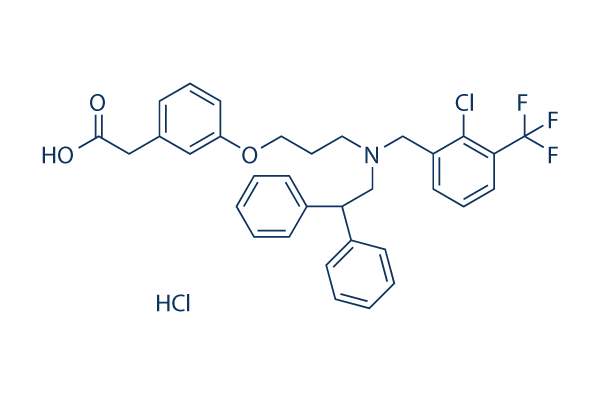
Structure chimique
Poids moléculaire: 618.51
Contrôle Qualité
Produits souvent utilisés avec GW3965 Hydrochloride
| Cibles apparentées | Dehydrogenase HSP Transferase P450 (e.g. CYP17) PDE phosphatase PPAR Vitamin Carbohydrate Metabolism Mitochondrial Metabolism |
|---|---|
| Autre Liver X Receptor Inhibiteurs | T0901317 LXR-623 (WAY-252623) GSK2033 SR9243 Abequolixron (RGX-104) AZ876 GSK3987 Desmosterol |
Culture cellulaire, traitement et concentration de travail
| Lignées cellulaires | Type dessai | Concentration | Temps dincubation | Formulation | Description de lactivité | PMID |
|---|---|---|---|---|---|---|
| HEK293 | 10 uM | 20 hrs | Activation of human LXRalpha expressed in HEK293 cells co-expressing human RXRalpha at 10 uM after 20 hrs by luciferase reporter gene assay | 28006909 | ||
| HEK293 | 10 uM | 20 hrs | Activation of rat LXRbeta expressed in HEK293 cells co-expressing human RXRalpha at 10 uM after 20 hrs by luciferase reporter gene assay | 28006909 | ||
| THP1 | Function assay | Induction of cholesterol efflux in THP1 cells, EC50 = 0.01 μM. | 17587573 | |||
| THP1 | Function assay | 18 hrs | Induction of cholesterol efflux in THP1 cells after 18 hrs, EC50 = 0.01 μM. | 17416521 | ||
| COS7 | Function assay | 16 hrs | Agonist activity at human LXRbeta receptor transfected in COS7 cells after 16 hrs by reporter transactivation assay, EC50 = 0.015 μM. | 17587573 | ||
| COS7 | Function assay | Activation of LXRbeta co-transfected in COS7 cells with RXRalpha by reporter transactivation assay, EC50 = 0.015 μM. | 17416521 | |||
| THP1 | Antiinflammatory assay | 6 hrs | Antiinflammatory activity against human THP1 cells assessed as inhibition of LPS-stimulated IL6 production after 6 hrs by ELISA, IC50 = 0.02 μM. | 18800767 | ||
| THP1 | Function assay | Agonist activity at GAL-linked human LXRbeta expressed in THP1 cells assessed as stimulation of co-activator recruitment by FRET assay, EC50 = 0.027 μM. | 17665897 | |||
| RAW264.7 | Function assay | 24 hrs | Induction of [3H]cholesterol efflux in mouse RAW264.7 cells loaded with acetylated-LDL after 24 hrs, EC50 = 0.029 μM. | 19717304 | ||
| THP1 | Function assay | Stimulation of [3H]cholesterol efflux in human THP1 foam cells loaded with ac-LDL, EC50 = 0.031 μM. | 18973288 | |||
| CV1 | Function assay | Antagonist activity at LXRbeta ligand binding domain assessed as inhibition of T1317-induced transcriptional activity in african green monkey CV1 cells co-transfected with Gal4-SRC1 by luciferase reporter assay, IC50 = 0.03981 μM. | 20345102 | |||
| THP1 | Function assay | Agonist activity at GAL-linked human LXRalpha expressed in THP1 cells assessed as stimulation of coactivator recruitment by FRET assay, EC50 = 0.097 μM. | 17665897 | |||
| CV1 | Function assay | Antagonist activity at LXRalpha ligand binding domain assessed as inhibition of T1317-induced transcriptional activity in african green monkey CV1 cells co-transfected with Gal4-SRC1 by luciferase reporter assay, IC50 = 0.1 μM. | 20345102 | |||
| SH-SY5Y | Function assay | 24 hrs | Agonist activity at human LXRbeta expressed in human SH-SY5Y cells co-transfected with Gal4-LBD after 24 hrs by luciferase reporter gene assay, EC50 = 0.13 μM. | 19264481 | ||
| HepG2 | Function assay | Effect on SREBP1c gene expression in human HepG2 cells, EC50 = 0.21 μM. | 18973288 | |||
| HuH7 | Function assay | Agonist activity at human recombinant LXRbeta ligand binding domain in human HuH7 cells co-transfected with fused Gal4-DBD by transactivation assay, EC50 = 0.31 μM. | 18973288 | |||
| SH-SY5Y | Function assay | 24 hrs | Agonist activity at human LXRalpha expressed in human SH-SY5Y cells co-transfected with Gal4-LBD after 24 hrs by luciferase reporter gene assay, EC50 = 0.31 μM. | 19264481 | ||
| CHO | Function assay | Agonist activity at human LXR beta receptor expressed in CHO cells by reporter assay, EC50 = 0.41 μM. | 17034119 | |||
| CHOK1 | Function assay | 24 hrs | Agonist activity at Gal4-tagged LXRbeta (unknown origin) expressed in CHOK1 cells after 24 hrs by luciferase reporter gene assay, EC50 = 0.42 μM. | 25677664 | ||
| THP1 | Function assay | Effect on ABCA1 gene expression in human differentiated THP1 cells, EC50 = 0.434 μM. | 18973288 | |||
| CV1 | Function assay | Agonist activity at LXRbeta ligand binding domain-mediated transcriptional activity in african green monkey CV1 cells co-transfected with Gal4-SRC1 by luciferase reporter assay, EC50 = 0.50119 μM. | 20345102 | |||
| HuH7 | Function assay | Agonist activity at human recombinant LXRalpha ligand binding domain in human HuH7 cells co-transfected with fused Gal4-DBD by transactivation assay, EC50 = 0.66 μM. | 18973288 | |||
| CV1 | Function assay | Agonist activity at LXRalpha ligand binding domain-mediated transcriptional activity in african green monkey CV1 cells co-transfected with Gal4-SRC1 by luciferase reporter assay, EC50 = 0.79433 μM. | 20345102 | |||
| CHOK1 | Function assay | 24 hrs | Agonist activity at Gal4-tagged LXRalpha (unknown origin) expressed in CHOK1 cells after 24 hrs by luciferase reporter gene assay, EC50 = 1.3 μM. | 25677664 | ||
| HepG2 | Function assay | Effect on triglyceride accumulation in human HepG2 cells, EC50 = 2.002 μM. | 18973288 | |||
| HepG2 | Function assay | 500 nM | Inhibition of 2-(3-(3-((2-chloro-3-(trifluoromethyl)benzyl)(2,2-diphenylethyl)amino)propoxy)phenyl)acetic acid-induced srebp1c mRNA expression in human HepG2 cells at 500 nM | 18800767 | ||
| HepG2 | Function assay | 500 nM | Inhibition of 2-(3-(3-((2-chloro-3-(trifluoromethyl)benzyl)(2,2-diphenylethyl)amino)propoxy)phenyl)acetic acid-induced fas mRNA expression in human HepG2 cells at 500 nM | 18800767 | ||
| RAW264.7 | Function assay | 1 uM | Reduction of LPS-stimulated iNOS gene expression in mouse RAW264.7 cells expressing LXRalpha at 1 uM by luciferase reporter gene assay | 18800767 | ||
| RAW264.7 | Function assay | 1 uM | Inhibition of LPS-stimulated nuclear co-repressor release from iNOS promoter in mouse RAW264.7 cells at 1 uM by RT-PCR | 18800767 | ||
| HeLa | Function assay | 1 uM | Induction of LXRbeta SUMOylation by SUMO2 in human HeLa cells at 1 uM by Western blot analysis | 18800767 | ||
| HeLa | Function assay | 1 uM | Induction of LXRbeta SUMOylation by SUMO3 in human HeLa cells at 1 uM by Western blot analysis | 18800767 | ||
| HeLa | Function assay | 1 uM | Induction of LXRalpha SUMOylation by SUMO3 in human HeLa cells at 1 uM by Western blot analysis | 18800767 | ||
| DAOY | qHTS assay | qHTS of pediatric cancer cell lines to identify multiple opportunities for drug repurposing: Primary screen for DAOY cells | 29435139 | |||
| SJ-GBM2 | qHTS assay | qHTS of pediatric cancer cell lines to identify multiple opportunities for drug repurposing: Primary screen for SJ-GBM2 cells | 29435139 | |||
| A673 | qHTS assay | qHTS of pediatric cancer cell lines to identify multiple opportunities for drug repurposing: Primary screen for A673 cells | 29435139 | |||
| SK-N-MC | qHTS assay | qHTS of pediatric cancer cell lines to identify multiple opportunities for drug repurposing: Primary screen for SK-N-MC cells | 29435139 | |||
| BT-37 | qHTS assay | qHTS of pediatric cancer cell lines to identify multiple opportunities for drug repurposing: Primary screen for BT-37 cells | 29435139 | |||
| NB-EBc1 | qHTS assay | qHTS of pediatric cancer cell lines to identify multiple opportunities for drug repurposing: Primary screen for NB-EBc1 cells | 29435139 | |||
| SK-N-SH | qHTS assay | qHTS of pediatric cancer cell lines to identify multiple opportunities for drug repurposing: Primary screen for SK-N-SH cells | 29435139 | |||
| BT-12 | qHTS assay | qHTS of pediatric cancer cell lines to identify multiple opportunities for drug repurposing: Primary screen for BT-12 cells | 29435139 | |||
| OHS-50 | qHTS assay | qHTS of pediatric cancer cell lines to identify multiple opportunities for drug repurposing: Primary screen for OHS-50 cells | 29435139 | |||
| RD | qHTS assay | qHTS of pediatric cancer cell lines to identify multiple opportunities for drug repurposing: Primary screen for RD cells | 29435139 | |||
| MG 63 (6-TG R) | qHTS assay | qHTS of pediatric cancer cell lines to identify multiple opportunities for drug repurposing: Primary screen for MG 63 (6-TG R) cells | 29435139 | |||
| Rh30 | qHTS assay | qHTS of pediatric cancer cell lines to identify multiple opportunities for drug repurposing: Primary screen for Rh30 cells | 29435139 | |||
| Rh41 | qHTS assay | qHTS of pediatric cancer cell lines to identify multiple opportunities for drug repurposing: Primary screen for Rh41 cells | 29435139 | |||
| Cliquez pour voir plus de données expérimentales sur la lignée cellulaire | ||||||
Informations chimiques, stockage et stabilité
| Poids moléculaire | 618.51 | Formule | C33H31ClF3NO3.HCl |
Stockage (À compter de la date de réception) | |
|---|---|---|---|---|---|
| N° CAS | 405911-17-3 | Télécharger le SDF | Stockage des solutions mères |
|
|
| Synonymes | N/A | Smiles | C1=CC=C(C=C1)C(CN(CCCOC2=CC=CC(=C2)CC(=O)O)CC3=C(C(=CC=C3)C(F)(F)F)Cl)C4=CC=CC=C4.Cl | ||
Solubilité
|
In vitro |
DMSO
: 100 mg/mL
(161.67 mM)
Water : Insoluble Ethanol : Insoluble |
Calculateur de molarité
|
In vivo |
|||||
Calculateur de formulation in vivo (Solution claire)
Étape 1 : Saisir les informations ci-dessous (Recommandé : Un animal supplémentaire pour tenir compte des pertes pendant lexpérience)
Étape 2 : Saisir la formulation in vivo (Ceci est seulement le calculateur, pas la formulation. Veuillez nous contacter dabord sil ny a pas de formulation in vivo dans la section Solubilité.)
Résultats du calcul :
Concentration de travail : mg/ml;
Méthode de préparation du liquide maître DMSO : mg médicament prédissous dans μL DMSO ( Concentration du liquide maître mg/mL, Veuillez nous contacter dabord si la concentration dépasse la solubilité du DMSO du lot de médicament. )
Méthode de préparation de la formulation in vivo : Prendre μL DMSO liquide maître, puis ajouterμL PEG300, mélanger et clarifier, puis ajouterμL Tween 80, mélanger et clarifier, puis ajouter μL ddH2O, mélanger et clarifier.
Méthode de préparation de la formulation in vivo : Prendre μL DMSO liquide maître, puis ajouter μL Huile de maïs, mélanger et clarifier.
Note : 1. Veuillez vous assurer que le liquide est clair avant dajouter le solvant suivant.
2. Assurez-vous dajouter le(s) solvant(s) dans lordre. Vous devez vous assurer que la solution obtenue, lors de lajout précédent, est une solution claire avant de procéder à lajout du solvant suivant. Des méthodes physiques telles que le vortex, les ultrasons ou le bain-marie chaud peuvent être utilisées pour faciliter la dissolution.
Mécanisme daction
| Targets/IC50/Ki |
hLXRβ
(Cell-free assay) 30 nM(EC50)
LXRα/SRC1 LiSA
(Cell-free assay) 125 nM(EC50)
hLXRα
(Cell-free assay) 190 nM(EC50)
|
|---|---|
| In vitro |
GW3965 recrute le coactivateur 1 du récepteur stéroïdien vers le LXRα humain avec une EC50 de 125 nM dans un essai de détection de ligand acellulaire. GW3965 montre une activité antagoniste puissante contre hLXRα et hLXRβ dans des essais basés sur des cellules avec des EC50 de 190 nM et 30 nM, respectivement. De plus, GW3965 présente également une excellente sélectivité par rapport à d'autres récepteurs nucléaires. Dans les îlots humains, GW3965 (1 μM) réduit l'expression de cytokines pro-inflammatoires sélectionnées, y compris l'IL-8, la protéine chimiotactique des monocytes-1 et le facteur tissulaire. |
| In vivo |
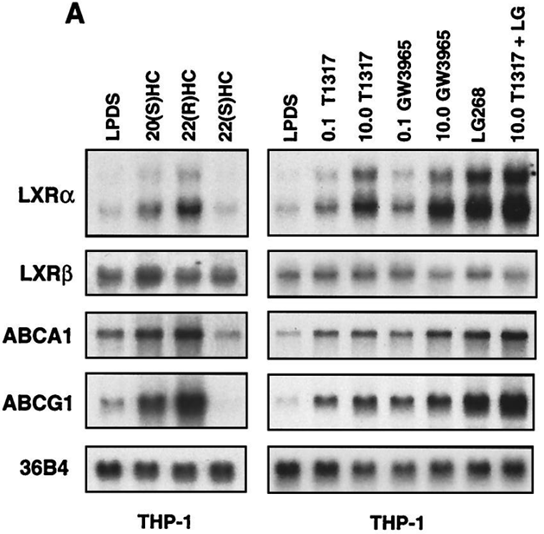
Chez les souris, GW3965 à une dose de 10 mg/kg régule à la hausse l'expression d'ABCA1 de 8 fois et augmente les niveaux circulants de HDL de 30% avec un Cmax de 12,7 μg/mL et une t1/2 de 2 heures. GW3965 (10 mg/kg) induit l'expression d'ABCA1 et d'ABCG1 et montre une puissante activité anti-athérogène chez les souris LDLR−/− et apoE−/−. Chez les rats Sprague-Dawley mâles, GW3965 réduit les augmentations de la pression artérielle médiées par l'Ang II et diminue l'expression du gène du récepteur vasculaire de l'Ang II. Dans le modèle murin de glioblastome, GW3965 entraîne une dégradation de LDLR médiée par un dégradeur inductible de LDLR, une expression accrue du transporteur d'efflux de cholestérol ABCA1, et favorise ainsi puissamment la mort des cellules tumorales. |
Références |
|
Applications
| Méthodes | Biomarqueurs | Images | PMID |
|---|---|---|---|
| Western blot | LXRα / LXRβ / ABCA1 / ABCG1 Skp2 / pEGFR / EGFR / pERK / ERK |
|
11604492 |
| Immunofluorescence | pRelA LAMP-1 / LDLR |
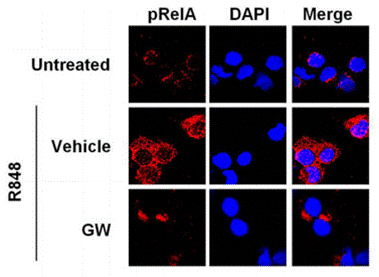
|
26635040 |
| Growth inhibition assay | Cell viability |
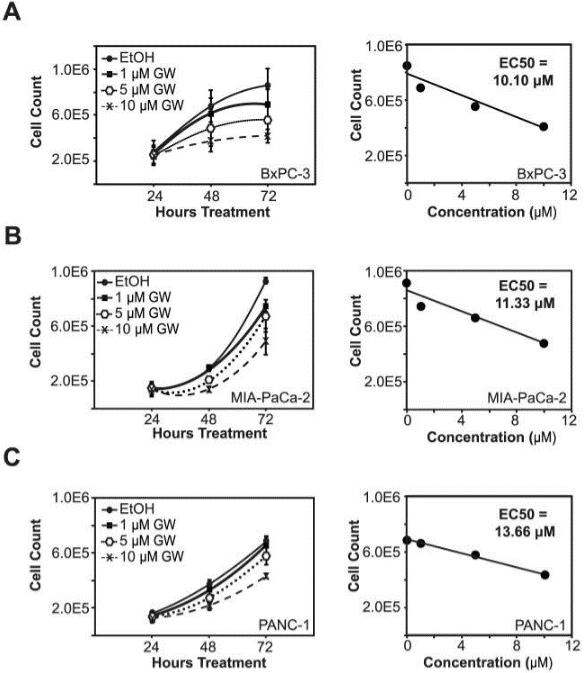
|
25184494 |
Support technique
Tel: +1-832-582-8158 Ext:3
Si vous avez dautres questions, veuillez laisser un message.
Foire aux questions
Question 1:
How to formulate it for mouse in vivo experiment?
Réponse :
It can be dissolved in 2% DMSO/30% PEG 300/dd H2O at 10 mg/mL as a homogeneous suspension. This vehicle is suitable for oral gavage to mice.

Les produits sont destinés à la recherche uniquement. Ne pas utiliser chez lhomme. Nous ne vendons pas aux patients.
©Copyright 2013 Selleck Chemicals. Tous droits réservés.