
pour la recherche uniquement
TAE226 (NVP-TAE226) FAK Inhibiteur
Réf. Catalogue: S2820
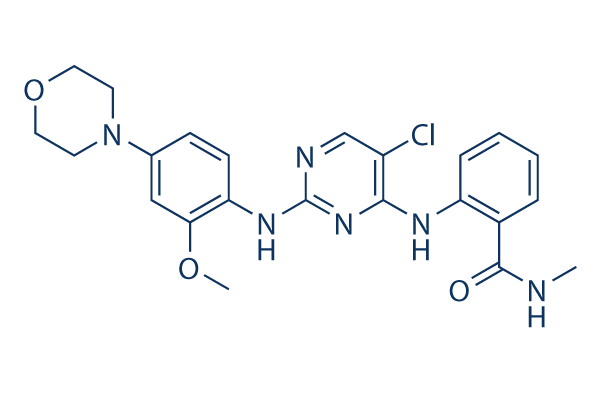
Structure chimique
Poids moléculaire: 468.94
Contrôle Qualité (Quality Control)
| Cibles apparentées | EGFR VEGFR JAK FGFR PDGFR Src HIF FLT3 HER2 FLT |
|---|---|
| Autre FAK Inhibiteurs | Defactinib (VS-6063) PF-562271 (VS-6062) PF-573228 VS-4718 (PND-1186) PF-562271 HCl PF-562271 Besylate GSK2256098 PF-431396 Y15 Solanesol (Nonaisoprenol) |
Culture cellulaire, traitement et concentration de travail
(Cell Culture, Treatment & Working Concentration)
| Lignées cellulaires | Type d'essai | Concentration | Temps d'incubation | Formulation | Description de l'activité | PMID |
|---|---|---|---|---|---|---|
| HCT116 cells | Proliferation assay | 48 h | Antiproliferative activity against human HCT116 cells after 48 hrs by WST-1 assay, IC50=0.4 μM | |||
| HUVEC | Function assay | 72 h | Antiangiogenic activity in HUVEC assessed as inhibition of VEGF-stimulated proliferation after 72 hrs by WST-1 assay, IC50=1 μM | |||
| U87MG cells | Proliferation assay | 48 h | Antiproliferative activity against human U87MG cells after 48 hrs by WST-1 assay, IC50=1.2 μM | |||
| PC3 cells | Proliferation assay | 48 h | Antiproliferative activity against human PC3 cells after 48 hrs by WST-1 assay, IC50=1.6 μM | |||
| MDA-MB-231 cells | Proliferation assay | 48 h | Antiproliferative activity against human MDA-MB-231 cells after 48 hrs by WST-1 assay, IC50=2.8 μM | |||
| BT474 cells | Function assay | 1 μM | 24 h | Induction of apoptosis in human BT474 cells assessed as cleavage of 89 kDa PARP at 1 uM after 24 hrs by Western blotting | ||
| Cliquez pour voir plus de données expérimentales sur la lignée cellulaire | ||||||
Informations chimiques, stockage et stabilité (Chemical Information, Storage & Stability)
| Poids moléculaire | 468.94 | Formule | C23H25ClN6O3 |
Stockage (À compter de la date de réception) | |
|---|---|---|---|---|---|
| N° CAS | 761437-28-9 | Télécharger le SDF | Stockage des solutions mères |
|
|
| Synonymes | N/A | Smiles | CNC(=O)C1=CC=CC=C1NC2=NC(=NC=C2Cl)NC3=C(C=C(C=C3)N4CCOCC4)OC | ||
Solubilité (Solubility)
|
In vitro |
DMSO
: 94 mg/mL
(200.45 mM)
Water : Insoluble Ethanol : Insoluble |
Calculateur de molarité
|
In vivo |
|||||
Calculateur de formulation in vivo (Solution claire)
Étape 1 : Saisir les informations ci-dessous (Recommandé : Un animal supplémentaire pour tenir compte des pertes pendant l'expérience)
Étape 2 : Saisir la formulation in vivo (Ceci est seulement le calculateur, pas la formulation. Veuillez nous contacter d'abord s'il n'y a pas de formulation in vivo dans la section Solubilité.)
Résultats du calcul :
Concentration de travail : mg/ml;
Méthode de préparation du liquide maître DMSO : mg médicament prédissous dans μL DMSO ( Concentration du liquide maître mg/mL, Veuillez nous contacter d'abord si la concentration dépasse la solubilité du DMSO du lot de médicament. )
Méthode de préparation de la formulation in vivo : Prendre μL DMSO liquide maître, puis ajouterμL PEG300, mélanger et clarifier, puis ajouterμL Tween 80, mélanger et clarifier, puis ajouter μL ddH2O, mélanger et clarifier.
Méthode de préparation de la formulation in vivo : Prendre μL DMSO liquide maître, puis ajouter μL Huile de maïs, mélanger et clarifier.
Note : 1. Veuillez vous assurer que le liquide est clair avant d'ajouter le solvant suivant.
2. Assurez-vous d'ajouter le(s) solvant(s) dans l'ordre. Vous devez vous assurer que la solution obtenue, lors de l'ajout précédent, est une solution claire avant de procéder à l'ajout du solvant suivant. Des méthodes physiques telles que le vortex, les ultrasons ou le bain-marie chaud peuvent être utilisées pour faciliter la dissolution.
Mécanisme d'action (Mechanism of Action)
| Targets/IC50/Ki |
PYK2
(cell-free assay) 3.5 nM
FAK
(cell-free assay) 5.5 nM
Insulin Receptor
(cell-free assay) 43.5 nM
IGF-1R
(cell-free assay) 140 nM
c-Met
(cell-free assay) 160 nM
FLT4
(cell-free assay) 220 nM
FLT1
(cell-free assay) 3.4 μM
|
|---|---|
| In vitro |
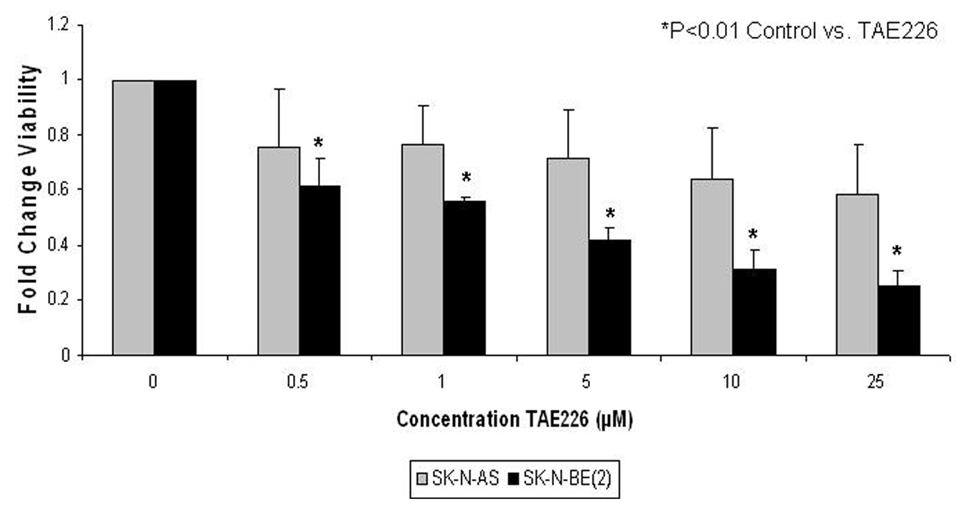
NVP-TAE226 (< 1 μM) inhibits extracellular matrix-induced autophosphorylation of FAK (Tyr397) in serum-starved U87 cells. This compound (< 1 μM) also inhibits IGF-I-induced phosphorylation of IGF-1R and activity of its downstream target genes such as MAPK and Akt in both U87 and U251 cells. This chemical (<10 μM) retards tumor cell growth and attenuats G(2)-M cell cycle progression associated with a decrease in cyclin B1 and phosphorylated cdc2 (Tyr15) protein expression in both U87 and U251 cells. This compound (1 μM) inhibits tumor cell invasion by at least 50% compared with the control in an in vitro Matrigel invasion assay in glioma cell lines. This chemical (1 μM) treatment of glioma cell lines containing wild-type p53 mainly exhibits G(2)-M arrest, whereas glioma cell lines bearing mutant p53 undergoes apoptosis, as evidence by detection of caspase-3/7 activation and poly(ADP-ribose) polymerase cleavage and by an Annexin V apoptosis assay. This compound (5 μM) inhibits phosphorylation of FAK in the human neuroblastoma cell line SK-N-AS. This chemical (<10 μM) treatment of the human neuroblastoma cell line SK-N-AS leads to decrease in cellular viability, cell cycle arrest, and an increase in apoptosis. This compound (0.1 μM-10 μM) inhibits tube formation of HMEC1 cells.
|
| In vivo |
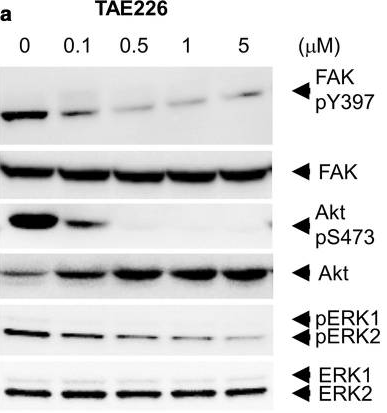
NVP-TAE226 (75 mg/kg) significantly increases the survival rate of mice bearing intracranial glioma xenografts. This compound (100 mg/kg, oral) exerts significant decrease in microvessel density in a human colon cancer model in SCID mice. This chemical (100 mg/kg, oral) efficiently inhibits MIA PaCa-2 human pancreatic tumor growth without body weight loss in vivo model. It inhibits 4T1 murine breast tumor growth and metastasis to the lung in a dose-dependent manner in vivo model, associated with inhibition of FAK autophosphorylation at Y397 and Akt phosphorylation at Serine473.
|
Références |
|
Applications (Applications)
| Méthodes | Biomarqueurs | Images | PMID |
|---|---|---|---|
| Growth inhibition assay | Cell viability |
|
21196322 |
| Western blot | FAK / p-FAK(Y397) / p-AKT(S473) / AKT / pERK / ERK |
|
31215459 |

Les produits sont destinés à la recherche uniquement. Ne pas utiliser chez l'homme. Nous ne vendons pas aux patients.
©Copyright 2013 Selleck Chemicals. Tous droits réservés.