
pour la recherche uniquement
Oxaliplatin inhibiteur de la synthèse de l'ADN
Réf. CatalogueS1224
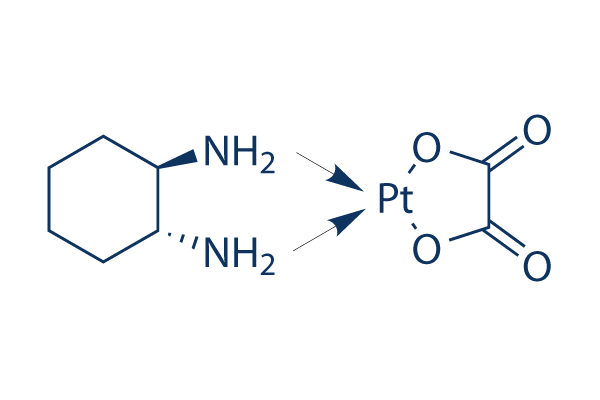
Structure chimique
Poids moléculaire: 397.29
Aller à
Contrôle Qualité
Lot :
Pureté :
99.78%
99.78
| Cibles apparentées | HDAC PARP ATM/ATR DNA-PK WRN Topoisomerase PPAR Sirtuin Casein Kinase eIF |
|---|---|
| Autre DNA/RNA Synthesis Inhibiteurs | CX-5461 (Pidnarulex) B02 SCR7 Favipiravir (T-705) EED226 RK-33 BMH-21 Triapine (3-AP) Carmofur YK-4-279 |
Culture cellulaire, traitement et concentration de travail
| Lignées cellulaires | Type dessai | Concentration | Temps dincubation | Formulation | Description de lactivité | PMID |
|---|---|---|---|---|---|---|
| Caco2 | Function Assay | 30/100 μM | 16 h | DMSO | activates Nrf2 | 24556415 |
| Caco2 | Function Assay | 3/10/30 μM | 16 h | DMSO | increases the mRNA levels of AKR1C1, NQO1, HO-1, MRP2, andMRP3 dose-dependently | 24556415 |
| Caco2 | Function Assay | 30 μM | 24 h | DMSO | induces the expression of HO-1, AKR1C, and NQO1 | 24556415 |
| SW620 | Growth Inhibition Assay | 10-70 mg/L | 24/48/72 h | inhibits cell growth in both time and dose dependent manner | 24646305 | |
| SW480 | Growth Inhibition Assay | 48 h | IC50=20.8 ug/mL | 24720675 | ||
| HCT116 | Function Assay | 2/5 µM | 24/48 h | suppresses survivin mRNA expression | 24761411 | |
| HT-29 | Growth Inhibition Assay | 1 μM | 0-72 h | inhibits cell growth in a time dependent manner | 24997451 | |
| SW480 | Growth Inhibition Assay | 1 μM | 0-72 h | inhibits cell growth in a time dependent manner | 24997451 | |
| HUVEC | Growth Inhibition Assay | IC50=11.30 ± 1.02 μM | 25307448 | |||
| HEK293 | Growth Inhibition Assay | IC50=8.82 ± 5.59 μM | 25307448 | |||
| HT-29 | Growth Inhibition Assay | IC50>50 μM | 25307448 | |||
| HCT-116 | Growth Inhibition Assay | IC50=6.24 ± 2.97 μM | 25307448 | |||
| MCF-7 | Growth Inhibition Assay | IC50=14.24 ± 1.82 μM | 25307448 | |||
| HepG2 | Growth Inhibition Assay | IC50=14.24 ± 1.82 μM | 25307448 | |||
| A549 | Growth Inhibition Assay | IC50=51.08 ± 10.96 μM | 25307448 | |||
| SGC7901 | Growth Inhibition Assay | IC50=21.73 ± 3.08 μM | 25307448 | |||
| COC1 | Growth Inhibition Assay | IC50=46.20 ± 3.14 μM | 25307448 | |||
| HCT116 | Growth Inhibition Assay | 72 h | IC50=6.23±0.75 µg/mL | 25360631 | ||
| SW480 | Growth Inhibition Assay | 72 h | IC50=10.7±2.26 µg/mL | 25360631 | ||
| MIAPaCa-2 | Function Assay | 25 µM | 24/48 h | induces cleavage of PARP, caspase-9, caspase-8 and caspase-3 | 25444914 | |
| Panc-1 | Function Assay | 25 µM | 24/48 h | induces cleavage of PARP, caspase-9, caspase-8 and caspase-3 | 25444914 | |
| MIAPaCa-2 | Apoptosis Assay | 25 µM | 24 h | induces apoptosis in a synergistic manner combined with WA | 25444914 | |
| Panc-1 | Apoptosis Assay | 25 µM | 24 h | induces apoptosis in a synergistic manner combined with WA | 25444914 | |
| HPDE | Cell Viability Assay | 25/50 μM | 24/48 h | inhibits proliferation of PC cells in a synergistic manner combined with WA | 25444914 | |
| SW1990 | Cell Viability Assay | 25/50 μM | 24/48 h | inhibits proliferation of PC cells in a synergistic manner combined with WA | 25444914 | |
| MIAPaCa-2 | Cell Viability Assay | 25/50 μM | 24/48 h | inhibits proliferation of PC cells in a synergistic manner combined with WA | 25444914 | |
| Panc-1 | Cell Viability Assay | 25/50 μM | 24/48 h | inhibits proliferation of PC cells in a synergistic manner combined with WA | 25444914 | |
| A549/CDDP | Growth Inhibition Assay | IC50=18.6 ± 1.2 μM | 25625243 | |||
| A549 | Growth Inhibition Assay | IC50=5.8 ± 0.6 μM | 25625243 | |||
| SW480 | Function Assay | 10 µg/ml | 24 h | enhances cellular autophagic flux | 25749420 | |
| SW620 | Function Assay | 10 µg/ml | 24 h | enhances cellular autophagic flux | 25749420 | |
| SW480 | Function Assay | 10 µg/ml | 24 h | increases LC3-II accumulation and decreases P62 expression | 25749420 | |
| SW620 | Function Assay | 10 µg/ml | 24 h | increases LC3-II accumulation and decreases P62 expression | 25749420 | |
| HT-29 | Growth Inhibition Assay | IC50=5.22 μM | 25761479 | |||
| SNU-175 | Growth Inhibition Assay | IC50=1.51 μM | 25761479 | |||
| COLO-320DM | Growth Inhibition Assay | IC50=5.38 μM | 25761479 | |||
| DLD-1 | Growth Inhibition Assay | IC50=8.65 μM | 25761479 | |||
| DiFi | Growth Inhibition Assay | IC50=10.95 μM | 25761479 | |||
| HCT-15 | Growth Inhibition Assay | IC50=8.64 μM | 25761479 | |||
| SCM-1 | Growth Inhibition Assay | IC50=17.5 μM | 25789057 | |||
| TMK-1 | Growth Inhibition Assay | IC50=22.6 μM | 25789057 | |||
| MKN-45 | Growth Inhibition Assay | IC50=14.0 μM | 25789057 | |||
| AGS | Growth Inhibition Assay | IC50=10.6 μM | 25789057 | |||
| S3 | Growth Inhibition Assay | IC50=53.5 ± 1.5 μM | 25801007 | |||
| SiHa | Growth Inhibition Assay | IC50=0.8 ± 0.1 μM | 25801007 | |||
| HT-29 | Growth Inhibition Assay | IC50=35.6 μM | 26003085 | |||
| DLD-1 | Growth Inhibition Assay | IC50=32.2 μM | 26003085 | |||
| HT29 | Growth Inhibition Assay | IC50=63 μM ± 18 | 26004084 | |||
| MC38 | Growth Inhibition Assay | IC50=23 μM ± 2 | 26004084 | |||
| SW620 | Growth Inhibition Assay | IC50=3.68 μM | 26023085 | |||
| SW480 | Growth Inhibition Assay | IC50=2.86 μM | 26023085 | |||
| RKO | Growth Inhibition Assay | IC50=1.23 μM | 26023085 | |||
| LoVo | Growth Inhibition Assay | IC50=1.2 μM | 26023085 | |||
| KM12 | Growth Inhibition Assay | IC50=4.37 μM | 26023085 | |||
| HCT116p53- | Growth Inhibition Assay | IC50=1.08 μM | 26023085 | |||
| HCT116 | Growth Inhibition Assay | IC50=1.04 μM | 26023085 | |||
| HCT15 | Growth Inhibition Assay | IC50=1.43 μM | 26023085 | |||
| HT29 | Growth Inhibition Assay | IC50=2.69 μM | 26023085 | |||
| DLD1 | Growth Inhibition Assay | IC50=2.01 μM | 26023085 | |||
| Colo205 | Growth Inhibition Assay | IC50=3.33 μM | 26023085 | |||
| BE | Growth Inhibition Assay | IC50=3.33 μM | 26023085 | |||
| CT26 | Cell Viability Assay | 4 mM | 48 h | decreases cell viability to 53.2% | 26137012 | |
| CT26 | Function Assay | 4 mM | 48 h | increases the expression levels of autophagy-related proteins, such as LC3-II, Beclin1 and ATG5 | 26137012 | |
| CT26 | Function Assay | 4 mM | 48 h | induces autophagy | 26137012 | |
| SK-OV-3 | Function Assay | 50 μM | 48 h | promotes sensitivity of ovarian carcinoma to NK cell-mediated cytolysis | 26138671 | |
| OVCAR-5 | Function Assay | 20 μM | 24h | promotes sensitivity of ovarian carcinoma to NK cell-mediated cytolysis | 26138671 | |
| PA-1 | Function Assay | 10 μM | 24h | promotes sensitivity of ovarian carcinoma to NK cell-mediated cytolysis | 26138671 | |
| SK-OV-3 | Function Assay | 50 μM | 96 h | up-regulates the stress ligands for NK cell-activating receptors and TRAIL receptors | 26138671 | |
| OVCAR-5 | Function Assay | 30 μM | 48h | up-regulates the stress ligands for NK cell-activating receptors and TRAIL receptors | 26138671 | |
| PA-1 | Function Assay | 10 μM | 48h | up-regulates the stress ligands for NK cell-activating receptors and TRAIL receptors | 26138671 | |
| SK-OV-3 | Function Assay | 50 μM | 96 h | triggeres the production of type I IFNs and chemokines | 26138671 | |
| OVCAR-5 | Function Assay | 30 μM | 48h | triggeres the production of type I IFNs and chemokines | 26138671 | |
| PA-1 | Function Assay | 10 μM | 24h | triggeres the production of type I IFNs and chemokines | 26138671 | |
| SK-OV-3 | Cell Viability Assay | 0-100 μM | 24/48/72 h | inhibits cell viability in both time and dose dependent manner | 26138671 | |
| OVCAR-5 | Cell Viability Assay | 0-60 μM | 24/48/72 h | inhibits cell viability in both time and dose dependent manner | 26138671 | |
| PA-1 | Cell Viability Assay | 0-20 μM | 24/48 h | inhibits cell viability in both time and dose dependent manner | 26138671 | |
| HCT116 | Growth Inhibition Assay | IC50=0.41 ± 0.02 μM | 26148596 | |||
| HT29 | Growth Inhibition Assay | IC50=0.88 ± 0.2 μM | 26148596 | |||
| SNU-387 | Growth Inhibition Assay | IC50=25 ± 2.7 μM | 26160429 | |||
| SNU-475 | Growth Inhibition Assay | IC50>30 μM | 26160429 | |||
| Hep-G2 | Growth Inhibition Assay | IC50=13.1 ± 1.6 μM | 26160429 | |||
| SNU-398 | Growth Inhibition Assay | IC50=6.5 ± 1.1 μM | 26160429 | |||
| LoVo | Function Assay | 1/5 μM | 24/48 h | induces transcriptional repression of DUT-N | 26208523 | |
| HCT116 p53+/+ | Function Assay | 1/5 μM | 24/48 h | induces transcriptional repression of DUT-N | 26208523 | |
| MDA-MB-231 | Growth Inhibition Assay | IC50=23.1 ± 0.1 μM | 26211591 | |||
| MCF-7 | Growth Inhibition Assay | IC50=15.4 ± 0.3 μM | 26211591 | |||
| SK-BR-3 | Growth Inhibition Assay | IC50=31.0 ± 0.1 μM | 26211591 | |||
| LoVo | Growth Inhibition Assay | 48 h | IC50=94.83 μM | 26269759 | ||
| HCT116 | Growth Inhibition Assay | 48 h | IC50=11.86 μM | 26269759 | ||
| SW480 | Growth Inhibition Assay | 48 h | IC50=1.87 μM | 26269759 | ||
| CaES-17 | Cytotoxicity Assay | 0–160 μM | 48 h | IC50=5.5 ± 0.2 μM | 26474693 | |
| HKESC-2 | Cytotoxicity Assay | 0–160 μM | 48 h | IC50=5.8 ± 0.5 μM | 26474693 | |
| Cliquez pour voir plus de données expérimentales sur la lignée cellulaire | ||||||
Informations chimiques, stockage et stabilité
| Poids moléculaire | 397.29 | Formule | C8H14N2O4Pt |
Stockage (À compter de la date de réception) | 2 years 4°C(in the dark) powder |
|---|---|---|---|---|---|
| N° CAS | 61825-94-3 | Télécharger le SDF | Stockage des solutions mères | Les solutions sont instables. Préparer des solutions fraîches ou acheter des formats petits et préemballés. Reconditionner dès réception. | |
| Synonymes | L-OHP,NSC 266046 | Smiles | C1CCC(C(C1)[NH-])[NH-].C(=O)(C(=O)O)O.[Pt+2] | ||
Solubilité
|
In vitro |
Water : 2 mg/mL Ethanol : Insoluble |
Calculateur de molarité
Calculateur de dilution
Calculateur de poids moléculaire
|
In vivo |
|||||
Calculateur de formulation in vivo (Solution claire)
Étape 1 : Saisir les informations ci-dessous (Recommandé : Un animal supplémentaire pour tenir compte des pertes pendant lexpérience)
mg/kg
g
μL
Étape 2 : Saisir la formulation in vivo (Ceci est seulement le calculateur, pas la formulation. Veuillez nous contacter dabord sil ny a pas de formulation in vivo dans la section Solubilité.)
% DMSO
%
% Tween 80
% ddH2O
%DMSO
%
Résultats du calcul :
Concentration de travail : mg/ml;
Méthode de préparation du liquide maître DMSO : mg médicament prédissous dans μL DMSO ( Concentration du liquide maître mg/mL, Veuillez nous contacter dabord si la concentration dépasse la solubilité du DMSO du lot de médicament. )
Méthode de préparation de la formulation in vivo : Prendre μL DMSO liquide maître, puis ajouterμL PEG300, mélanger et clarifier, puis ajouterμL Tween 80, mélanger et clarifier, puis ajouter μL ddH2O, mélanger et clarifier.
Méthode de préparation de la formulation in vivo : Prendre μL DMSO liquide maître, puis ajouter μL Huile de maïs, mélanger et clarifier.
Note : 1. Veuillez vous assurer que le liquide est clair avant dajouter le solvant suivant.
2. Assurez-vous dajouter le(s) solvant(s) dans lordre. Vous devez vous assurer que la solution obtenue, lors de lajout précédent, est une solution claire avant de procéder à lajout du solvant suivant. Des méthodes physiques telles que le vortex, les ultrasons ou le bain-marie chaud peuvent être utilisées pour faciliter la dissolution.
Mécanisme daction
| Caractéristiques |
This product is not recommended to be dissolved in dimethylsulfoxide (DMSO).
|
|---|---|
| Targets/IC50/Ki |
DNA synthesis
(RT4, TCCSUP, A2780, HT-29, U-373MG, U-87MG, SK-MEL-2, HT-144 cells) |
| In vitro |
Le principal mécanisme d'action d'Oxaliplatin est médié par la formation d'adduits d'ADN. Ce composé induit des lésions primaires et secondaires de l'ADN qui conduisent à l'apoptose cellulaire. Il est actif contre les lignées cellulaires de mélanome humain C32 et G361 avec des IC50 de 0,98 mM et 0,14 mM, respectivement. Ce produit chimique inhibe efficacement les lignées cellulaires de carcinome de la vessie RT4 et TCCSUP, la lignée cellulaire de carcinome ovarien A2780, la lignée cellulaire de carcinome du côlon HT-29, les lignées cellulaires de glioblastome U-373MG et U-87MG, et les lignées cellulaires de mélanome SK-MEL-2 et HT-144 avec des IC50 de 11 μM, 15 μM, 0,17 μM, 0,97 μM, 2,95 μM, 17,6 μM, 30,9 μM et 7,85 μM, respectivement. |
| In vivo |
Une injection hebdomadaire i.p. d'Oxaliplatin à 10 mg/kg chez des souris nues porteuses de tumeurs hépatocellulaires HCCLM3 réduit significativement le volume tumoral et l'indice apoptotique. Ce composé (5 mg/kg, i.v. les jours 1, 5 et 9) est actif sur la leucémie-lymphome à cellules T L40 AKR avec un T/C de 1,77. Il est également efficace sur la leucémie L1210 greffée intracérébralement, les xénogreffes MA 16-C, les xénogreffes de mélanome B16, les xénogreffes pulmonaires de Lewis et les xénogreffes de carcinome du côlon C26. Ce produit chimique induit une altération du transport neuronal rétrograde chez la souris. |
Références |
|
Applications
| Méthodes | Biomarqueurs | Images | PMID |
|---|---|---|---|
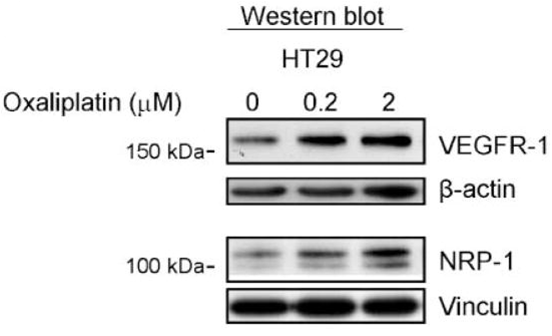
| Western blot | VEGFR-1 / NRP-1 p-AKT(Ser473) / AKT / PTEN / p-Src(Tyr416) p-Src(Y418) / p-FAK(Y861) |
|
18790786 |
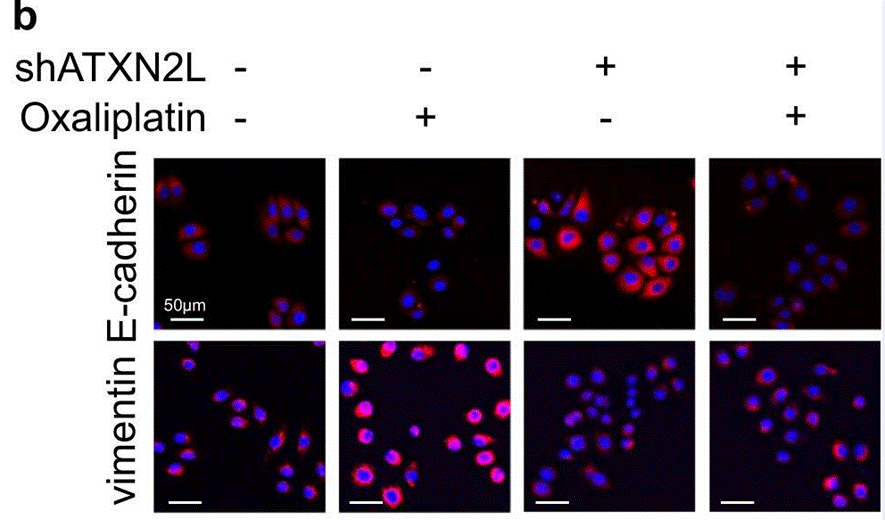
| Immunofluorescence | E-cadherin / Vimentin ATXN2L / G3BP1 |
|
30787271 |
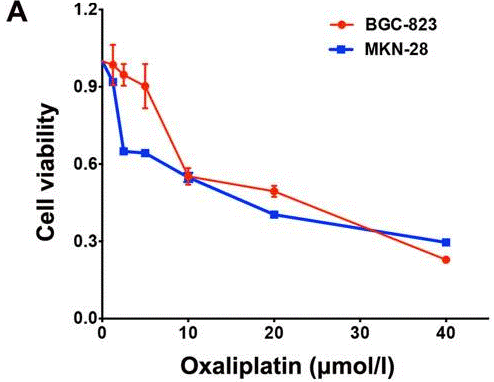
| Growth inhibition assay | Cell viability |
|
28339092 |
Informations sur lessai clinique
(données du https://clinicaltrials.gov, mis à jour le 2024-05-22)
| Numéro NCT | Recrutement | Conditions | Promoteur/Collaborateurs | Date de début | Phases |
|---|---|---|---|---|---|
| NCT06320301 | Recruiting | Biliary Tract Cancer|Gemox Chemotherapy |
Sun Yat-Sen Memorial Hospital of Sun Yat-Sen University|Suzhou Suncadia Biopharmaceuticals Co. Ltd. |
April 1 2024 | Phase 2 |
| NCT05922358 | Not yet recruiting | Gastrointestinal Tumors |
Fujian Cancer Hospital |
September 1 2023 | Phase 2 |
| NCT05780684 | Recruiting | Colorectal Cancer|Esophagus Cancer|Appendix Cancer|Small Bowel Cancer|Ampullary Cancer |
Dartmouth-Hitchcock Medical Center |
July 14 2023 | Not Applicable |
| NCT05322590 | Recruiting | Metastatic Colorectal Carcinoma|Neuropathy |
Bexion Pharmaceuticals Inc.|ICON plc|CTI Clinical Trial and Consulting Services |
January 9 2023 | Phase 1|Phase 2 |
Support technique
Tel: +1-832-582-8158 Ext:3
Si vous avez dautres questions, veuillez laisser un message.
Foire aux questions
Question 1:
Is it ok to dissolve it in saline?
Réponse :
When dissolved in saline, it is partially converted to cisplatin and L-isomers. The L-isomer of this compound is inactive. DMF is a better choice.
Question 2:
Is it ok to dissolve it in DMSO?
Réponse :
Even though it is soluble in DMSO, the use of DMSO to dissolve this compound in biological studies is strongly discouraged. The DMSO inserts itself into the ligand and inactivates platin-containing compounds. DMF is a much better choice than DMSO.

Les produits sont destinés à la recherche uniquement. Ne pas utiliser chez lhomme. Nous ne vendons pas aux patients.
©Copyright 2013 Selleck Chemicals. Tous droits réservés.