
pour la recherche uniquement
YK-4-279 DNA/RNA Synthesis inhibiteur
Réf. CatalogueS7679
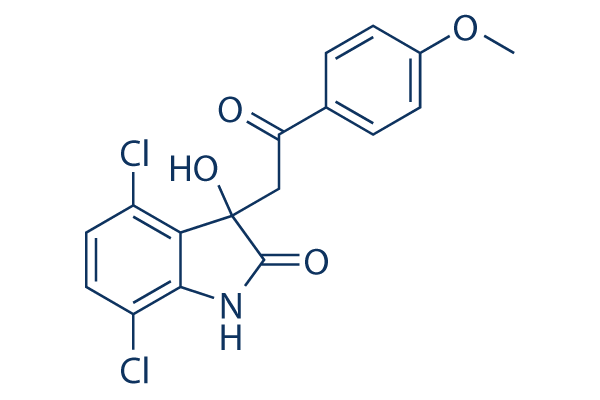
Structure chimique
Poids moléculaire: 366.20
Contrôle Qualité
| Cibles apparentées | CDK HSP PD-1/PD-L1 ROCK Wee1 Microtubule Associated Ras KRas Aurora Kinase Casein Kinase |
|---|---|
| Autre DNA/RNA Synthesis Inhibiteurs | CX-5461 (Pidnarulex) B02 SCR7 Favipiravir (T-705) EED226 RK-33 BMH-21 Triapine (3-AP) Carmofur Halofuginone |
Culture cellulaire, traitement et concentration de travail
| Lignées cellulaires | Type dessai | Concentration | Temps dincubation | Formulation | Description de lactivité | PMID |
|---|---|---|---|---|---|---|
| COS7 | Function assay | Inhibition of transcriptional activity of full-length EWS-FLI1 (unknown origin) expressed in COS7 cells by NR0B1-luciferase reporter gene assay, IC50=0.35μM | 25432018 | |||
| TC71 | Growth inhibition assay | 3 days | Growth inhibition of human TC71 cells harboring EWS-FLI1 fusion protein after 3 days by WST1 assay, GI50=0.92μM | 25432018 | ||
| TC32 | Growth inhibition assay | 3 days | Growth inhibition of human TC32 cells harboring EWS-FLI1 fusion protein after 3 days by WST1 assay, GI50=0.94μM | 25432018 | ||
| TC32 | qHTS assay | qHTS of pediatric cancer cell lines to identify multiple opportunities for drug repurposing: Primary screen for TC32 cells | 29435139 | |||
| DAOY | qHTS assay | qHTS of pediatric cancer cell lines to identify multiple opportunities for drug repurposing: Primary screen for DAOY cells | 29435139 | |||
| SJ-GBM2 | qHTS assay | qHTS of pediatric cancer cell lines to identify multiple opportunities for drug repurposing: Primary screen for SJ-GBM2 cells | 29435139 | |||
| A673 | qHTS assay | qHTS of pediatric cancer cell lines to identify multiple opportunities for drug repurposing: Primary screen for A673 cells | 29435139 | |||
| SK-N-MC | qHTS assay | qHTS of pediatric cancer cell lines to identify multiple opportunities for drug repurposing: Primary screen for SK-N-MC cells | 29435139 | |||
| NB-EBc1 | qHTS assay | qHTS of pediatric cancer cell lines to identify multiple opportunities for drug repurposing: Primary screen for NB-EBc1 cells | 29435139 | |||
| Saos-2 | qHTS assay | qHTS of pediatric cancer cell lines to identify multiple opportunities for drug repurposing: Primary screen for Saos-2 cells | 29435139 | |||
| LAN-5 | qHTS assay | qHTS of pediatric cancer cell lines to identify multiple opportunities for drug repurposing: Primary screen for LAN-5 cells | 29435139 | |||
| BT-12 | qHTS assay | qHTS of pediatric cancer cell lines to identify multiple opportunities for drug repurposing: Primary screen for BT-12 cells | 29435139 | |||
| OHS-50 | qHTS assay | qHTS of pediatric cancer cell lines to identify multiple opportunities for drug repurposing: Primary screen for OHS-50 cells | 29435139 | |||
| RD | qHTS assay | qHTS of pediatric cancer cell lines to identify multiple opportunities for drug repurposing: Primary screen for RD cells | 29435139 | |||
| MG 63 (6-TG R) | qHTS assay | qHTS of pediatric cancer cell lines to identify multiple opportunities for drug repurposing: Primary screen for MG 63 (6-TG R) cells | 29435139 | |||
| Rh41 | qHTS assay | qHTS of pediatric cancer cell lines to identify multiple opportunities for drug repurposing: Primary screen for Rh41 cells | 29435139 | |||
| Cliquez pour voir plus de données expérimentales sur la lignée cellulaire | ||||||
Informations chimiques, stockage et stabilité
| Poids moléculaire | 366.20 | Formule | C17H13Cl2NO4 |
Stockage (À compter de la date de réception) | |
|---|---|---|---|---|---|
| N° CAS | 1037184-44-3 | Télécharger le SDF | Stockage des solutions mères |
|
|
| Synonymes | N/A | Smiles | COC1=CC=C(C=C1)C(=O)CC2(C3=C(C=CC(=C3NC2=O)Cl)Cl)O | ||
Solubilité
|
In vitro |
DMSO
: 73 mg/mL
(199.34 mM)
Ethanol : 73 mg/mL Water : Insoluble |
Calculateur de molarité
|
In vivo |
|||||
Calculateur de formulation in vivo (Solution claire)
Étape 1 : Saisir les informations ci-dessous (Recommandé : Un animal supplémentaire pour tenir compte des pertes pendant lexpérience)
Étape 2 : Saisir la formulation in vivo (Ceci est seulement le calculateur, pas la formulation. Veuillez nous contacter dabord sil ny a pas de formulation in vivo dans la section Solubilité.)
Résultats du calcul :
Concentration de travail : mg/ml;
Méthode de préparation du liquide maître DMSO : mg médicament prédissous dans μL DMSO ( Concentration du liquide maître mg/mL, Veuillez nous contacter dabord si la concentration dépasse la solubilité du DMSO du lot de médicament. )
Méthode de préparation de la formulation in vivo : Prendre μL DMSO liquide maître, puis ajouterμL PEG300, mélanger et clarifier, puis ajouterμL Tween 80, mélanger et clarifier, puis ajouter μL ddH2O, mélanger et clarifier.
Méthode de préparation de la formulation in vivo : Prendre μL DMSO liquide maître, puis ajouter μL Huile de maïs, mélanger et clarifier.
Note : 1. Veuillez vous assurer que le liquide est clair avant dajouter le solvant suivant.
2. Assurez-vous dajouter le(s) solvant(s) dans lordre. Vous devez vous assurer que la solution obtenue, lors de lajout précédent, est une solution claire avant de procéder à lajout du solvant suivant. Des méthodes physiques telles que le vortex, les ultrasons ou le bain-marie chaud peuvent être utilisées pour faciliter la dissolution.
Mécanisme daction
| Targets/IC50/Ki |
RHA
|
|---|---|
| In vitro |
YK-4-279 élimine les niveaux de cycline D en bloquant l'interaction de EWS-FLI1 avec RHA dans les cellules TC32 contenant EWS-FLI1. Ce composé inhibe également spécifiquement la croissance des cellules ESFT et induit l'apoptose. Il inhibe également l'activité biologique d'ERG et d'ETV1 dans les cellules de cancer de la prostate fusion-positives, et diminue davantage la motilité et l'invasion cellulaire.
|
| In vivo |
In vivo, YK-4-279 (1,5 mg/dose i.p.) inhibe la croissance des tumeurs de xénogreffe ESFT. Dans le modèle murin, ce composé prévient sélectivement la croissance et la métastase du cancer de la prostate dans les tumeurs LNCaP-luc-M6 fusion-positives.
|
Références |
|
Applications
| Méthodes | Biomarqueurs | Images | PMID |
|---|---|---|---|
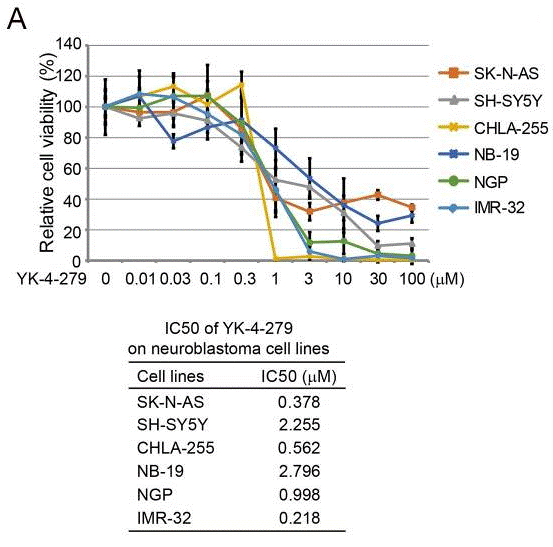
| Growth inhibition assay | Cell viability |
|
29212266 |
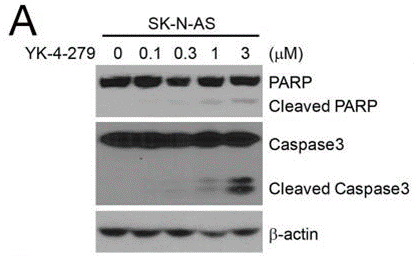
| Western blot | PARP / Cleaved PARP / Caspase 3 / Cleaved Caspase 3 p-HH3(Ser10) / Histone H3 / p-Aurora A (T288) / Aurora A / Aurora B / Cyclin B / p53 / p21 |
|
29212266 |
Support technique
Tel: +1-832-582-8158 Ext:3
Si vous avez dautres questions, veuillez laisser un message.
Foire aux questions
Question 1:
I would like to know whether it is the racemate version, or whether it is the + R-enantiomer or the – S-enantiomer of this compound?
Réponse :
For our S7679, it is a recemate.

Les produits sont destinés à la recherche uniquement. Ne pas utiliser chez lhomme. Nous ne vendons pas aux patients.
©Copyright 2013 Selleck Chemicals. Tous droits réservés.