
pour la recherche uniquement
MK-8776 (SCH 900776) Chk Inhibiteur
Réf. Catalogue: S2735
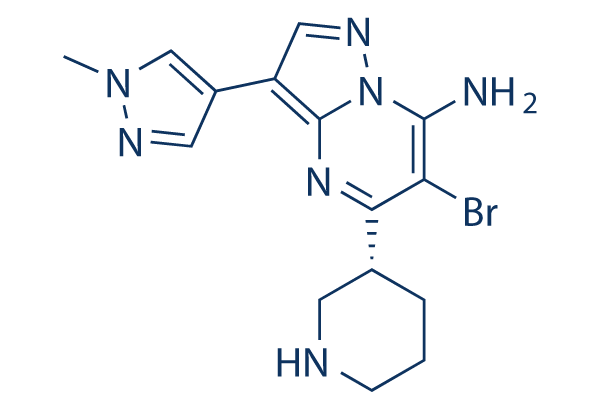
Structure chimique
Poids moléculaire: 376.25
Contrôle Qualité (Quality Control)
Culture cellulaire, traitement et concentration de travail
(Cell Culture, Treatment & Working Concentration)
| Lignées cellulaires | Type d'essai | Concentration | Temps d'incubation | Formulation | Description de l'activité | PMID |
|---|---|---|---|---|---|---|
| SKOV3 | Growth Inhibition Assay | 0.3 µM | 8 d | sensitizes the cell lines to | 23548269 | |
| BxPC-3 | Growth Inhibition Assay | 10-1000 nM | 24-48h | enhances the chemosensitization to | 23804422 | |
| MiaPaCa-2 | Growth Inhibition Assay | 10-1000 nM | 24-48h | enhances the chemosensitization to | 23804422 | |
| AsPC-1 | Growth Inhibition Assay | 10-1000 nM | 24-48h | enhances the chemosensitization to | 23804422 | |
| H1299 | Growth Inhibition Assay | 500 nM | 24 h | DMSO | enhances the chemosensitization to PMX | 24113549 |
| H1993 | Growth Inhibition Assay | 500 nM | 24 h | DMSO | enhances the chemosensitization to PMX | 24113549 |
| H1437 | Growth Inhibition Assay | 500 nM | 24 h | DMSO | enhances the chemosensitization to PMX | 24113549 |
| H23 | Growth Inhibition Assay | 500 nM | 24 h | DMSO | enhances the chemosensitization to PMX | 24113549 |
| AsPC-1 | Growth Inhibition Assay | 200/2000 nM | 24 h | decreases the IC50 of | 24359526 | |
| TK10 | Growth Inhibition Assay | 200/2000 nM | 24 h | decreases the IC50 of | 24359526 | |
| A498 | Growth Inhibition Assay | 200/2000 nM | 24 h | decreases the IC50 of | 24359526 | |
| U20S | Growth Inhibition Assay | 200/2000 nM | 24 h | decreases the IC50 of | 24359526 | |
| SNB19 | Growth Inhibition Assay | 200/2000 nM | 24 h | decreases the IC50 of | 24359526 | |
| MDA-MB-435 | Growth Inhibition Assay | 200/2000 nM | 24 h | decreases the IC50 of | 24359526 | |
| U87 | Growth Inhibition Assay | 200/2000 nM | 24 h | decreases the IC50 of | 24359526 | |
| HCC2998 | Growth Inhibition Assay | 200/2000 nM | 24 h | decreases the IC50 of | 24359526 | |
| MDA-MB-231 | Growth Inhibition Assay | 200/2000 nM | 24 h | decreases the IC50 of | 24359526 | |
| MiaPaCa-2 | Growth Inhibition Assay | 200/2000 nM | 24 h | decreases the IC50 of | 24359526 | |
| MCF10A | Growth Inhibition Assay | 200/2000 nM | 24 h | decreases the IC50 of | 24359526 | |
| HCT116 | Growth Inhibition Assay | 200/2000 nM | 24 h | decreases the IC50 of | 24359526 | |
| IGROV-1 | Growth Inhibition Assay | 200/2000 nM | 24 h | decreases the IC50 of | 24359526 | |
| SW620 | Growth Inhibition Assay | 200/2000 nM | 24 h | decreases the IC50 of | 24359526 | |
| HCT115 | Growth Inhibition Assay | 200/2000 nM | 24 h | decreases the IC50 of | 24359526 | |
| U251 | Growth Inhibition Assay | 200/2000 nM | 24 h | decreases the IC50 of | 24359526 | |
| OVCAR-8 | Growth Inhibition Assay | 0.3 µM | 8 d | sensitizes the cell lines to | 23548269 | |
| MV-4-11 | Apoptosis Assay | 100-700 nM | 48 h | induces apoptosis dose dependently | 23536721 | |
| U937 | Apoptosis Assay | 100-700 nM | 48 h | induces apoptosis dose dependently | 23536721 | |
| MOLM-13 | Apoptosis Assay | 100-700 nM | 48 h | induces apoptosis dose dependently | 23536721 | |
| A2058 | Cell Viability Assay | 37.5-300 nM | 72 h | DMSO | reduces the MK-1775 EC50 by 5-fold to an average of 45 nM | 23148684 |
| H2009 | Cell Viability Assay | 500 nM | 72 h | DMSO | results in G1/S-phase accumulation combined with MK-1775 | 23148684 |
| Su.86.86 | Cell Viability Assay | 500 nM | 72 h | DMSO | results in G1/S-phase accumulation combined with MK-1775 | 23148684 |
| HRE | Cell Viability Assay | 500 nM | 72 h | DMSO | results in G1/S-phase accumulation combined with MK-1775 | 23148684 |
| HMEC | Cell Viability Assay | 500 nM | 72 h | DMSO | results in G1/S-phase accumulation combined with MK-1775 | 23148684 |
| U2OS | Function Assay | 2 µM | 0-24 h | induces phosphorylation of Chk1 at serine 345 at both concentrations as early as 2 h after administration | 22937147 | |
| U2OS | Growth Inhibition Assay | 0-10 µM | 24/48 h | inhibits cell growth dose dependently | 22937147 | |
| U937 | Function Assay | 100-500 nM | 4 h | decreases the cytarabine-induced Chk1 autophosphorylation at Ser296 and prevents Cdc25A downregulation | 22869869 | |
| U937 | Function Assay | 100 nM | 4 h | reverses the cytarabine-induced inhibition of 3H-thymidine incorporation into DNA | 22869869 | |
| U937 | Function Assay | 100-500 nM | 4 h | induces increased phosphorylation of H2AX | 22869869 | |
| HL-60 | Apoptosis Assay | 30/100/300 nM | 24 h | DMSO | enhances cytarabine-induced apoptosis | 22869869 |
| ML-1 | Apoptosis Assay | 25/50/100 nM | 24 h | DMSO | enhances cytarabine-induced apoptosis | 22869869 |
| HCT116 | Function Assay | 1 µM | 24 h | abrogates of cell cycle arrest | 22510560 | |
| U2OS | Function Assay | 1 µM | 24 h | abrogates of cell cycle arrest | 22510560 | |
| Sf9 | Function assay | Inhibition of recombinant CDK2/Cyclin A expressed in insect Sf9 cells assessed as inhibition of [33P]-ATP incorporation into biotinylated histone H1 after 1 hr by liquid scintillation counting, IC50 = 0.16 μM. | 21094607 | |||
| Cliquez pour voir plus de données expérimentales sur la lignée cellulaire | ||||||
Informations chimiques, stockage et stabilité (Chemical Information, Storage & Stability)
| Poids moléculaire | 376.25 | Formule | C15H18BrN7 |
Stockage (À compter de la date de réception) | |
|---|---|---|---|---|---|
| N° CAS | 891494-63-6 | Télécharger le SDF | Stockage des solutions mères |
|
|
| Synonymes | N/A | Smiles | CN1C=C(C=N1)C2=C3N=C(C(=C(N3N=C2)N)Br)C4CCCNC4 | ||
Solubilité (Solubility)
|
In vitro |
DMSO
: 75 mg/mL
(199.33 mM)
Water : Insoluble Ethanol : Insoluble |
Calculateur de molarité
|
In vivo |
|||||
Calculateur de formulation in vivo (Solution claire)
Étape 1 : Saisir les informations ci-dessous (Recommandé : Un animal supplémentaire pour tenir compte des pertes pendant l'expérience)
Étape 2 : Saisir la formulation in vivo (Ceci est seulement le calculateur, pas la formulation. Veuillez nous contacter d'abord s'il n'y a pas de formulation in vivo dans la section Solubilité.)
Résultats du calcul :
Concentration de travail : mg/ml;
Méthode de préparation du liquide maître DMSO : mg médicament prédissous dans μL DMSO ( Concentration du liquide maître mg/mL, Veuillez nous contacter d'abord si la concentration dépasse la solubilité du DMSO du lot de médicament. )
Méthode de préparation de la formulation in vivo : Prendre μL DMSO liquide maître, puis ajouterμL PEG300, mélanger et clarifier, puis ajouterμL Tween 80, mélanger et clarifier, puis ajouter μL ddH2O, mélanger et clarifier.
Méthode de préparation de la formulation in vivo : Prendre μL DMSO liquide maître, puis ajouter μL Huile de maïs, mélanger et clarifier.
Note : 1. Veuillez vous assurer que le liquide est clair avant d'ajouter le solvant suivant.
2. Assurez-vous d'ajouter le(s) solvant(s) dans l'ordre. Vous devez vous assurer que la solution obtenue, lors de l'ajout précédent, est une solution claire avant de procéder à l'ajout du solvant suivant. Des méthodes physiques telles que le vortex, les ultrasons ou le bain-marie chaud peuvent être utilisées pour faciliter la dissolution.
Mécanisme d'action (Mechanism of Action)
| Targets/IC50/Ki |
Chk1
(Cell-free assay) 3 nM
CDK2
(Cell-free assay) 0.16 μM
|
|---|---|
| In vitro |
MK-8776 (SCH 900776) is a less potent inhibitor of Chk2 and CDK2 with IC50 of 1.5 μM and 0.16 μM, respectively. It shows no significant inhibition of cytochrome P450 human liver microsomal isoforms 1A2, 2C9, 2C19, 2D6, and 3A4. In combination with an antimetabolite, this compound induces accumulation of γ-H2AX within 2 hours, indicative of replication fork collapse and double stranded DNA breaks. Additionally, it suppresses accumulation of the Chk1 pS296 autophosphorylation in a dose-dependent manner. Exposure of proliferating WS1 cells to SCH 900776 is associated with rapid, dose-dependent accumulation of Chk1 pS345, indicating that cycling populations of normal cells induce Chk1 pS345 following exposure to it as part of a futile cycle, perhaps driven by AT-family kinases and DNA-PK. |
| Essai kinase |
Essai Chk1 SPA
|
|
Un essai in vitro utilisant la His-Chk1 recombinante exprimée dans le système d'expression du baculovirus comme source d'enzyme et un peptide biotinylé basé sur CDC25C comme substrat. La His-Chk1 est diluée à 32 nM dans un tampon kinase contenant 50 mM Tris pH 8,0, 10 mM MgCl2 et 1 mM DTT. Le peptide CDC25C (peptide biotinylé C-terminal CDC25 Ser216) est dilué à 1,93 μM dans le tampon kinase. Pour chaque réaction de kinase, 20 μL de solution enzymatique Chk1 à 32 nM et 20 μL de CDC25C à 1,926 μM sont mélangés et combinés avec 10 μL de MK-8776 (SCH 900776) dilué dans 10 % de DMSO, ce qui donne des concentrations finales de réaction de 6,2 nM Chk1, 385 nM CDC25C et 1 % de DMSO après addition de la solution de démarrage. La réaction est initiée par l'addition de 50 μL de solution de démarrage composée de 2 μM ATP et de 0,2 μCi de 33P-ATP, ce qui donne une concentration finale de réaction de 1 μM ATP, avec 0,2 μCi de 33P-ATP par réaction. Les réactions de kinase durent 2 heures à température ambiante et sont arrêtées par l'addition de 100 μL de solution d'arrêt composée de 2 M NaCl, 1 % H3PO4 et 5 mg/mL de billes SPA recouvertes de streptavidine. Les billes SPA sont capturées à l'aide d'une plaque filtrante GF/B à 96 puits et d'un récolteur universel Filtermate. Les billes sont lavées deux fois avec 2 M NaCl et deux fois avec 2 M NaCl avec 1 % d'acide phosphorique. Le signal est ensuite analysé à l'aide d'un compteur à scintillation liquide TopCount à 96 puits. Des courbes dose-réponse sont générées à partir de dilutions en série doubles en 8 points de ce composé. Les valeurs d'IC50 sont dérivées par analyse de régression non linéaire.
|
|
| In vivo |
Dose escalation of MK-8776 (SCH 900776) (16 mg/kg and 32 mg/kg) induces incremental improvements in tumor response. Importantly, doses of this compound associate with robust biomarker activation and improved tumor response are not associated with enhanced toxicity on hematological parameters in BALB/c mice. |
Références |
|
Applications (Applications)
| Méthodes | Biomarqueurs | Images | PMID |
|---|---|---|---|
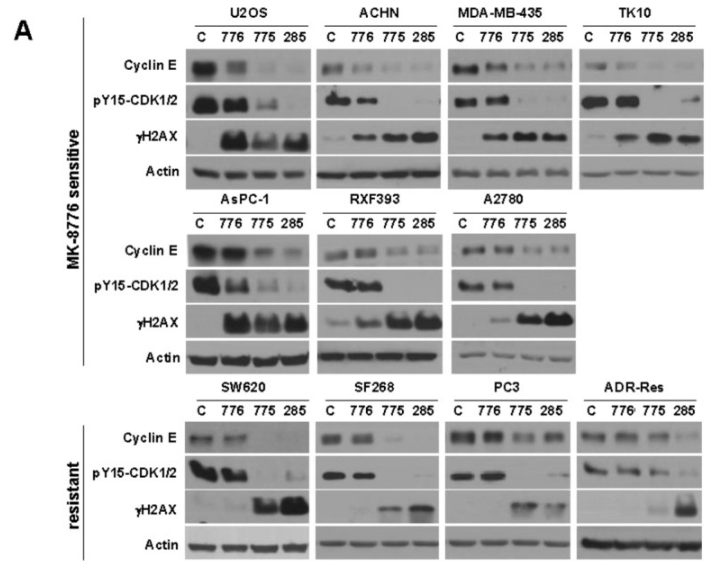
| Western blot | Cyclin E / pY15-CDK / γH2AX p-chk1(ser345) / CDC25A |
|
26595527 |
Informations sur l'essai clinique (Clinical Trial Information)
(données du https://clinicaltrials.gov, mis à jour le 2016-09-01)
| Numéro NCT | Recrutement | Conditions | Promoteur/Collaborateurs | Date de début | Phases |
|---|---|---|---|---|---|
| NCT01870596 | COMPLETED | Adult Acute Megakaryoblastic Leukemia; Adult Acute Monoblastic Leukemia; Adult Acute Monocytic Leukemia; Adult Acute Myeloid Leukemia With Inv(16)(p13.1q22); CBFB-MYH11; Adult Acute Myeloid Leukemia With Maturation; Adult Acute Myeloid Leukemia With Minimal Differentiation; Adult Acute Myeloid Leukemia With t(16;16)(p13.1;q22); CBFB-MYH11; Adult Acute Myeloid Leukemia With t(8;21)(q22;q22); RUNX1-RUNX1T1; Adult Acute Myeloid Leukemia With t(9;11)(p22;q23); MLLT3-MLL; Adult Acute Myeloid Leukemia Without Maturation; Adult Acute Myelomonocytic Leukemia; Adult Erythroleukemia; Adult Pure Erythroid Leukemia; Alkylating Agent-Related Acute Myeloid Leukemia; Recurrent Adult Acute Myeloid Leukemia |
National Cancer Institute (NCI) |
2013-05 | PHASE2 |
| NCT01521299 | WITHDRAWN | Advanced Solid Tumors |
Dartmouth-Hitchcock Medical Center |
2012-03 | PHASE1 |
| NCT00907517 | TERMINATED | Myelogenous Leukemia, Acute; Leukemia, Lymphocytic, Acute; Leukemia, Lymphoblastic, Acute, Philadelphia-Positive; Myelogenous Leukemia, Chronic, Aggressive Phase |
Merck Sharp & Dohme LLC |
2009-07-29 | PHASE1 |
| NCT00779584 | COMPLETED | Hodgkin Disease; Lymphoma, Non-Hodgkin; Neoplasms |
Merck Sharp & Dohme LLC |
2008-10-17 | PHASE1 |
| NCT00779584 | Completed | Hodgkin Disease|Lymphoma Non-Hodgkin|Neoplasms |
Merck Sharp & Dohme LLC |
2008-10-17 | Phase 1 |
Foire aux questions (Frequently Asked Questions)
Question 1:
I would like to know whether your product S2735 is the optically pure R enantiomer or whether it is a racemic mix.
Réponse :
It is the R enantiomer of our S2735.

Les produits sont destinés à la recherche uniquement. Ne pas utiliser chez l'homme. Nous ne vendons pas aux patients.
©Copyright 2013 Selleck Chemicals. Tous droits réservés.