
pour la recherche uniquement
Isoniazid Fatty Acid Synthase Inhibiteur
Réf. Catalogue: S1937
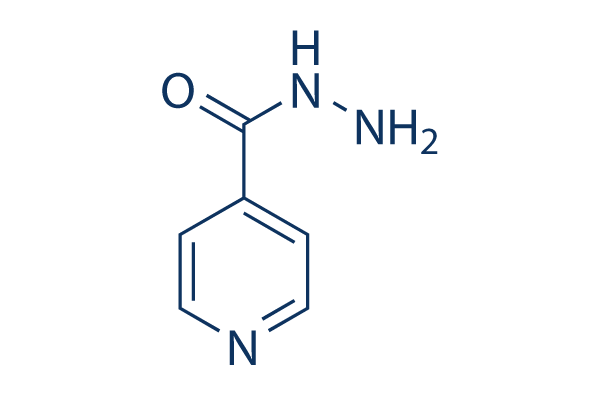
Structure chimique
Poids moléculaire: 137.14
Contrôle Qualité (Quality Control)
| Cibles apparentées | Dehydrogenase HSP Transferase P450 (e.g. CYP17) PDE phosphatase PPAR Vitamin Carbohydrate Metabolism Mitochondrial Metabolism |
|---|---|
| Autre Fatty Acid Synthase Inhibiteurs | Denifanstat (TVB-2640) Fatostatin TVB-3664 C75 Betulin FT113 C75 trans Sodium palmitate Desoxyrhaponticin Praeruptorin B |
Informations chimiques, stockage et stabilité (Chemical Information, Storage & Stability)
| Poids moléculaire | 137.14 | Formule | C6H7N3O |
Stockage (À compter de la date de réception) | |
|---|---|---|---|---|---|
| N° CAS | 54-85-3 | Télécharger le SDF | Stockage des solutions mères |
|
|
| Synonymes | N/A | Smiles | C1=CN=CC=C1C(=O)NN | ||
Solubilité (Solubility)
|
In vitro |
DMSO
: 27 mg/mL
(196.87 mM)
Water : 27 mg/mL Ethanol : 27 mg/mL |
Calculateur de molarité
|
In vivo |
|||||
Calculateur de formulation in vivo (Solution claire)
Étape 1 : Saisir les informations ci-dessous (Recommandé : Un animal supplémentaire pour tenir compte des pertes pendant l'expérience)
Étape 2 : Saisir la formulation in vivo (Ceci est seulement le calculateur, pas la formulation. Veuillez nous contacter d'abord s'il n'y a pas de formulation in vivo dans la section Solubilité.)
Résultats du calcul :
Concentration de travail : mg/ml;
Méthode de préparation du liquide maître DMSO : mg médicament prédissous dans μL DMSO ( Concentration du liquide maître mg/mL, Veuillez nous contacter d'abord si la concentration dépasse la solubilité du DMSO du lot de médicament. )
Méthode de préparation de la formulation in vivo : Prendre μL DMSO liquide maître, puis ajouterμL PEG300, mélanger et clarifier, puis ajouterμL Tween 80, mélanger et clarifier, puis ajouter μL ddH2O, mélanger et clarifier.
Méthode de préparation de la formulation in vivo : Prendre μL DMSO liquide maître, puis ajouter μL Huile de maïs, mélanger et clarifier.
Note : 1. Veuillez vous assurer que le liquide est clair avant d'ajouter le solvant suivant.
2. Assurez-vous d'ajouter le(s) solvant(s) dans l'ordre. Vous devez vous assurer que la solution obtenue, lors de l'ajout précédent, est une solution claire avant de procéder à l'ajout du solvant suivant. Des méthodes physiques telles que le vortex, les ultrasons ou le bain-marie chaud peuvent être utilisées pour faciliter la dissolution.
Mécanisme d'action (Mechanism of Action)
| In vitro |
Isoniazid is a prodrug that requires activation by the mycobacterial catalase-peroxidase enzyme (KatG) to an active form that then exerts a lethal effect on an intracellular target or targets. This compound upregulates the expression of an operon containing five FAS II components, including kasA and acpM. It results in the accumulation of ACP-bound lipid precursors to mycolic acids that are 26 carbons long and fully saturated. This chemical enters the mycobacterial cell by passive diffusion. It itself is not toxic to the bacterial cell, but acts as a prodrug and is activated by the mycobacterial enzyme KatG, a multifunctional catalase-peroxidase that has other activities, including peroxynitritase and NADH oxidase. The agent inhibits cell wall lipid synthesis, coupled with the findings that inhibitory INH adducts of NAD+/NADP+ are formed from the isonicotinoyl radical, leading the field away from this area. It induces a concentration-dependent (0-40 mM) cytotoxic effect in day-1 treated HepG2 cells and not significantly affected by decreases in intracellular GSH concentrations.
|
|---|---|
| In vivo |
Isoniazid increases CYP2E1 protein, and the 6-hydroxychlorzoxazone formation rate is increased by 2.7 and 2.2-fold in liver and kidney, respectively. This compound decreases liver and kidney 20-HETE content to 34% and 15.6% of control, respectively, without significantly altering tissue 19-HETE concentration.
|
Références |
|
Informations sur l'essai clinique (Clinical Trial Information)
(données du https://clinicaltrials.gov, mis à jour le 2025-03-17)
| Numéro NCT | Recrutement | Conditions | Promoteur/Collaborateurs | Date de début | Phases |
|---|---|---|---|---|---|
| NCT03785106 | ACTIVE_NOT_RECRUITING | HIV-infected Participants With Latent TB Infection in High TB Burden Country |
The HIV Netherlands Australia Thailand Research Collaboration |
2019-08-15 | PHASE3 |
| NCT07656012 | NOT_YET_RECRUITING | Tuberculosis |
University of Wisconsin, Madison |
2026-09 | PHASE2 |
| NCT07076225 | NOT_YET_RECRUITING | Pulmonary Tuberculosis |
Shenzhen Third People's Hospital |
2025-07-25 | PHASE3 |
| NCT03474029 | RECRUITING | Latent Tuberculosis |
Centers for Disease Control and Prevention |
2019-08-01 | PHASE2; PHASE3 |
| NCT07595042 | NOT_YET_RECRUITING | Tuberculosis |
National Institute of Allergy and Infectious Diseases (NIAID) |
2026-10-30 | PHASE2 |
| NCT06526221 | ENROLLING_BY_INVITATION | Tuberculosis, Pulmonary; Medication Adherence |
Tufts University |
2026-04-07 |

Les produits sont destinés à la recherche uniquement. Ne pas utiliser chez l'homme. Nous ne vendons pas aux patients.
©Copyright 2013 Selleck Chemicals. Tous droits réservés.