
pour la recherche uniquement
Alvespimycin (17-DMAG) Hydrochloride HSP Inhibiteur
Réf. Catalogue: S1142
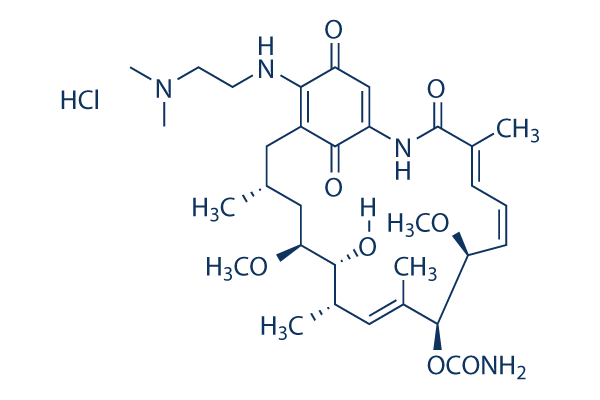
Structure chimique
Poids moléculaire: 653.21
Contrôle Qualité (Quality Control)
Culture cellulaire, traitement et concentration de travail
(Cell Culture, Treatment & Working Concentration)
| Lignées cellulaires | Type d'essai | Concentration | Temps d'incubation | Formulation | Description de l'activité | PMID |
|---|---|---|---|---|---|---|
| MDA-MB-231 | Function assay | Inhibition of Hsp90 in human MDA-MB-231 cells assessed as her2 degradation, IC50=0.0045μM. | 18929486 | |||
| A2058 | Cytotoxicity assay | Cytotoxicity against human A2058 cells by MTT assay, IC50=0.0021μM. | 18929486 | |||
| AGS | Cytotoxicity assay | Cytotoxicity against human AGS cells by MTT assay, IC50=16μM. | 18359631 | |||
| HeLa | Cytotoxicity assay | Cytotoxicity against human HeLa cells by MTT assay, IC50=2.06μM. | 18359631 | |||
| HeLa | Function assay | Inhibition of TNF-alpha-induced NF-kappaB activation in human HeLa cells, IC50=0.15μM. | 18359631 | |||
| AGS | Function assay | Inhibition of hypoxia-induced HIF1 activation in human AGS cells by reporter gene assay, IC50=0.0036μM. | 18359631 | |||
| NCI-H526 | Function assay | 1 uM | 96 hrs | Inhibition of HSP90-mediated proliferation of human NCI-H526 cells at 1 uM after 96 hrs by sulforhodamine B assay | 17603540 | |
| NCI-H526 | Function assay | 1 uM | 24 hrs | Binding affinity to HSP90 in human NCI-H526 cells at 1 uM after 24 hrs by fluorescence polarization assay | 17603540 | |
| AGS | Function assay | 24 hrs | Viability of human AGS cells under normoxic conditions after 24 hrs by MTT assay, IC50=16μM. | 17583950 | ||
| Hep3B | Function assay | 16 hrs | Inhibition of HIF1 activation in human Hep3B cells assessed as inhibition of hypoxia-induced luciferase expression after 16 hrs by reporter assay, IC50=0.061μM. | 17583950 | ||
| AGS | Function assay | 16 hrs | Inhibition of HIF1 activation in human AGS cells assessed as inhibition of hypoxia-induced luciferase expression after 16 hrs by reporter assay, IC50=0.036μM. | 17583950 | ||
| SKOV3 | Function assay | Degradation of Her2 in SKOV3 cells, EC50=0.046μM. | 16854066 | |||
| SKOV3 | Function assay | Upregulation of Hsp70 in SKOV3 cells, EC50=0.014μM. | 16854066 | |||
| SKBR3 | Function assay | Degradation of Her2 in SKBR3 cells, EC50=0.008μM. | 16854066 | |||
| SKBR3 | Function assay | Upregulation of Hsp70 in SKBR3 cells, EC50=0.004μM. | 16854066 | |||
| SKBr3 | Cytotoxicity assay | Cytotoxicity against SKBr3 cells, IC50=0.024μM. | 16165354 | |||
| MDA-MB-231 | Cytotoxicity assay | Cytotoxicity against human MDA-MB-231 cells by MTT assay, IC50=0.0058μM. | 18929486 | |||
| A2058 | Function assay | Inhibition of Hsp90 in human A2058 cells, EC50=0.0079μM. | 18929486 | |||
| MDA-MB-231 | Function assay | Inhibition of Hsp90 in human MDA-MB-231 cells assessed as Akt degradation, IC50=0.0176μM. | 18929486 | |||
| A2058 | Function assay | Inhibition of Hsp90 in human A2058 cells assessed as Akt degradation, IC50=0.0243μM. | 18929486 | |||
| HuH7 | Antiviral assay | 3 days | Antiviral activity against Hepatitis C virus genotype 1b Con1 infected in human HuH7 cells assessed as GAPDH RNA or 18S rRNA level after 3 days by qRT-PCR analysis, EC50=0.0012μM. | 18936191 | ||
| HuH7 | Antiviral assay | 3 days | Antiviral activity against Hepatitis C virus genotype 1b Con1 infected in human HuH7 cells assessed as GAPDH RNA or 18S rRNA level after 3 days selected with 40 nM HCV-796 and 800 nM boceprevir by qRT-PCR analysis, EC50=0.0031μM. | 18936191 | ||
| SKBR3 | Function assay | Binding affinity to Hsp90 in human SKBR3 cells, IC50=0.024μM. | 19017562 | |||
| Hep3B | Function assay | 30 mins | Inhibition of hypoxia-induced HIF1alpha protein accumulation in human Hep3B cells treated for 30 mins measured after 12 hrs by Western blot analysis, IC50=0.0572μM. | 19072214 | ||
| Hep3B | Function assay | 16 hrs | Inhibition of hypoxia-induced VEGF protein secretion in human Hep3B cells after 16 hrs by ELISA, IC50=0.0795μM. | 19072214 | ||
| HCT116 | Cytotoxicity assay | 72 hrs | Cytotoxicity against human HCT116 cells after 72 hrs, IC50=0.057μM. | 19231864 | ||
| SKBR3 | Cytotoxicity assay | 72 hrs | Cytotoxicity against human SKBR3 cells after 72 hrs, IC50=0.058μM. | 19231864 | ||
| MCF7 | Cytotoxicity assay | 72 hrs | Cytotoxicity against human MCF7 cells after 72 hrs, IC50=0.071μM. | 19231864 | ||
| SKOV3 | Cytotoxicity assay | 72 hrs | Cytotoxicity against human SKOV3 cells after 72 hrs, IC50=0.122μM. | 19231864 | ||
| SKBR3 | Cytotoxicity assay | 72 hrs | Cytotoxicity against human SKBR3 cells after 72 hrs in presence of NQO1 inhibitor dicoumarol, IC50=0.23μM. | 19231864 | ||
| MCF7 | Cytotoxicity assay | 72 hrs | Cytotoxicity against human MCF7 cells after 72 hrs in presence of NQO1 inhibitor dicoumarol, IC50=0.862μM. | 19231864 | ||
| NCI-H596 | Cytotoxicity assay | 72 hrs | Cytotoxicity against NQ01-deficient human NCI-H596 cells after 72 hrs, IC50=1.1μM. | 19231864 | ||
| MDA468 | Cytotoxicity assay | 72 hrs | Cytotoxicity against NQ01-deficient human MDA468 cells after 72 hrs, IC50=1.6μM. | 19231864 | ||
| SKBR3 | Cytotoxicity assay | 72 hrs | Cytotoxicity against human SKBR3 cells after 72 hrs by celltiter-glo assay, IC50=0.024μM. | 19405528 | ||
| A549 | Cytotoxicity assay | 72 hrs | Cytotoxicity against human A549 cells after 72 hrs by celltiter-glo assay, IC50=0.068μM. | 19405528 | ||
| SKOV3 | Cytotoxicity assay | 72 hrs | Cytotoxicity against human SKOV3 cells after 72 hrs by celltiter-glo assay, IC50=0.22μM. | 19405528 | ||
| MCF7 | Cytotoxicity assay | 72 hrs | Cytotoxicity against human MCF7 cells after 72 hrs by celltiter-glo assay, IC50=0.23μM. | 19405528 | ||
| CCRF-CEM | Cytotoxicity assay | 72 hrs | Cytotoxicity against human CCRF-CEM cells after 72 hrs by celltiter-96 aqueous one solution assay, IC50=0.54μM. | 19405528 | ||
| CCRF-CEM | Cytotoxicity assay | 72 hrs | Cytotoxicity against human paclitaxel-resistant CCRF-CEM cells after 72 hrs by celltiter-96 aqueous one solution assay, IC50=2.5μM. | 19405528 | ||
| Hep3B | Function assay | 30 mins | Inhibition of hypoxia-induced HIF1alpha protein accumulation in human Hep3B cells treated for 30 mins measured after 12 hrs by Western blot analysis, IC50=0.057μM. | 20469887 | ||
| Hep3B | Function assay | 16 hrs | Inhibition of hypoxia-induced VEGF protein secretion in human Hep3B cells after 16 hrs by ELISA, IC50=0.079μM. | 20469887 | ||
| HCT116 | Cytotoxicity assay | Cytotoxicity against human HCT116 cells by Alamar blue assay, IC50=0.05μM. | 20662534 | |||
| NCI-H1299 | Function assay | 24 hrs | Inhibition of human HSP90 in human NCI-H1299 cells assessed as Akt degradation after 24 hrs by luminex assay, IC50=0.1μM. | 21438541 | ||
| LN229-Lux | Function assay | 2.5 to 10 uM | 1 hr | Inhibition of luciferase activity in human LN229-Lux cells at 2.5 to 10 uM incubated for 1 hr under normoxia followed by 24 hrs under hypoxia by reporter gene assay | 22746274 | |
| MCF7 | Antiproliferative assay | 48 hrs | Antiproliferative activity against human MCF7 cells assessed as inhibition of cell viability after 48 hrs by MTT assay, IC50=0.39μM. | 24582477 | ||
| HCT116 | Antiproliferative assay | 48 hrs | Antiproliferative activity against human HCT116 cells assessed as inhibition of cell viability after 48 hrs by MTT assay, IC50=0.78μM. | 24582477 | ||
| SKBR3 | Antiproliferative assay | 48 hrs | Antiproliferative activity against human SKBR3 cells assessed as inhibition of cell viability after 48 hrs by MTT assay, IC50=1.34μM. | 24582477 | ||
| A231 | Antiproliferative assay | 48 hrs | Antiproliferative activity against human A231 cells after 48 hrs by MTT assay, IC50=0.17μM. | 24763261 | ||
| MCF7 | Antiproliferative assay | 48 hrs | Antiproliferative activity against human MCF7 cells after 48 hrs by MTT assay, IC50=0.8μM. | 24763261 | ||
| HCT116 | Antiproliferative assay | 48 hrs | Antiproliferative activity against human HCT116 cells after 48 hrs by MTT assay, IC50=1.21μM. | 24763261 | ||
| SKBR3 | Antiproliferative assay | 48 hrs | Antiproliferative activity against human SKBR3 cells after 48 hrs by MTT assay, IC50=3.11μM. | 24763261 | ||
| NCI-H1299 | Function assay | 12 hrs | Reduction in oxygen consumption rate in human NCI-H1299 cells incubated for 12 hrs | 25383915 | ||
| PC9 | Cytotoxicity assay | 72 hrs | Cytotoxicity against HGF-induced erlotinib-resistant human PC9 cells assessed as inhibition of cell growth after 72 hrs by MTT assay, IC50=0.01μM. | 26844689 | ||
| Ma1 | Cytotoxicity assay | 72 hrs | Cytotoxicity against HGF-induced erlotinib-resistant human Ma1 cells assessed as inhibition of cell growth after 72 hrs by MTT assay, IC50=0.01μM. | 26844689 | ||
| SKBR3 | Function assay | Inhibition of Hsp90 in human SKBR3 cells, IC50=0.024μM. | 26844689 | |||
| HeLa | Function assay | 10 uM | 6 hrs | Inhibition of HSP90 in human HeLa cells assessed as induction of chk1 degradation at 10 uM after 6 hrs by Western blot method | 28816449 | |
| HeLa | Function assay | 10 uM | 6 hrs | Inhibition of HSP90 in human HeLa cells assessed as induction of Akt degradation at 10 uM after 6 hrs by Western blot method | 28816449 | |
| HeLa | Function assay | 10 uM | 6 hrs | Inhibition of HSP90 in human HeLa cells assessed as induction of HSP70 protein expression at 10 uM after 6 hrs by Western blot method | 28816449 | |
| PC3 | Function assay | 10 uM | 6 hrs | Inhibition of HSP90 in human PC3 cells assessed as induction of chk1 degradation at 10 uM after 6 hrs by Western blot method | 28816449 | |
| PC3 | Function assay | 10 uM | 6 hrs | Inhibition of HSP90 in human PC3 cells assessed as induction of Akt degradation at 10 uM after 6 hrs by Western blot method | 28816449 | |
| PC3 | Function assay | 10 uM | 6 hrs | Inhibition of HSP90 in human PC3 cells assessed as induction of HSP70 protein expression at 10 uM after 6 hrs by Western blot method | 28816449 | |
| Cliquez pour voir plus de données expérimentales sur la lignée cellulaire | ||||||
Informations chimiques, stockage et stabilité (Chemical Information, Storage & Stability)
| Poids moléculaire | 653.21 | Formule | C32H48N4O8•HCl |
Stockage (À compter de la date de réception) | |
|---|---|---|---|---|---|
| N° CAS | 467214-21-7 | Télécharger le SDF | Stockage des solutions mères |
|
|
| Synonymes | NSC 707545,BMS 826476 HCl,KOS 1022 | Smiles | CC1CC(C(C(C=C(C(C(C=CC=C(C(=O)NC2=CC(=O)C(=C(C1)C2=O)NCCN(C)C)C)OC)OC(=O)N)C)C)O)OC.Cl | ||
Solubilité (Solubility)
|
In vitro |
DMSO
: 100 mg/mL
(153.09 mM)
Water : Insoluble Ethanol : Insoluble |
Calculateur de molarité
|
In vivo |
|||||
Calculateur de formulation in vivo (Solution claire)
Étape 1 : Saisir les informations ci-dessous (Recommandé : Un animal supplémentaire pour tenir compte des pertes pendant l'expérience)
Étape 2 : Saisir la formulation in vivo (Ceci est seulement le calculateur, pas la formulation. Veuillez nous contacter d'abord s'il n'y a pas de formulation in vivo dans la section Solubilité.)
Résultats du calcul :
Concentration de travail : mg/ml;
Méthode de préparation du liquide maître DMSO : mg médicament prédissous dans μL DMSO ( Concentration du liquide maître mg/mL, Veuillez nous contacter d'abord si la concentration dépasse la solubilité du DMSO du lot de médicament. )
Méthode de préparation de la formulation in vivo : Prendre μL DMSO liquide maître, puis ajouterμL PEG300, mélanger et clarifier, puis ajouterμL Tween 80, mélanger et clarifier, puis ajouter μL ddH2O, mélanger et clarifier.
Méthode de préparation de la formulation in vivo : Prendre μL DMSO liquide maître, puis ajouter μL Huile de maïs, mélanger et clarifier.
Note : 1. Veuillez vous assurer que le liquide est clair avant d'ajouter le solvant suivant.
2. Assurez-vous d'ajouter le(s) solvant(s) dans l'ordre. Vous devez vous assurer que la solution obtenue, lors de l'ajout précédent, est une solution claire avant de procéder à l'ajout du solvant suivant. Des méthodes physiques telles que le vortex, les ultrasons ou le bain-marie chaud peuvent être utilisées pour faciliter la dissolution.
Mécanisme d'action (Mechanism of Action)
| Caractéristiques |
A synthetic derivative Geldanamycin, with lower hepatotoxicity than parent antibiotic & higher potency and bioavailability than the similar derivative 17-AAG.
|
|---|---|
| Targets/IC50/Ki |
HSP90
(Cell-free assay) 62 nM
|
| In vitro |
17-DMAG displays ~2 times potency against human Hsp90 than 17-AAG, with IC50 of 62 nM versus 119 nM. In SKBR3 and SKOV3 cells which over-express Hsp90 client protein Her2, 17-DMAG causes down-regulation of Her2 with EC50 of 8 nM and 46 nM, respectively, as well as induction of Hsp70 with EC50 of 4 nM and 14 nM, respectively, leading to significant cytotoxicity with GI50 of 29 nM and 32 nM, respectively, consistent with Hsp90 inhibition. 17-DMAG in combination with vorinostat synergistically induces apoptosis of the cultured MCL cells as well as primary MCL cells, more potently than either agent alone, by markedly attenuating the levels of cyclin D1 and CDK4, as well as of c-Myc, c-RAF and Akt. In contrast to 17-AAG which is only active for IKKβ in chronic lymphocytic leukemia (CLL) cells, 17-DMAG treatment effectively leads to depletion of the Hsp90 client protein, resulting in diminished NF-κB p50/p65 DNA binding, decreased NF-κB target gene transcription, and caspase-dependent apoptosis. By targeting the NF-κB family, 17-DMAG selectively mediates dose- and time-dependent cytotoxicity against CLL cells, but not normal T cells or NK cells important for immune surveillance. |
| Essai kinase |
Test de liaison compétitive basé sur la polarisation de fluorescence (FP)
|
|
Ce test utilise un analogue de la geldanamycine marqué au difluorure de bore-dipyrrométhène (BODIPY-AG) comme sonde et mesure la polarisation de fluorescence lors de la liaison de la sonde à une protéine. La protéine Hsp90 humaine native (isoformes α + β) est isolée des cellules HeLa. La solution de BODIPY-AG est fraîchement préparée dans le tampon d'essai FP (20 mM HEPES-KOH, pH 7,3, 1,0 mM EDTA, 100 mM KCl, 5,0 mM MgCl2, 0,01 % NP-40, 0,1 mg/mL de γ-globuline bovine (BGG) fraîche, 1,0 mM de DTT frais, et un inhibiteur de protéase provenant d'une solution stock dans le DMSO. Des courbes de compétition sont obtenues en mélangeant 10 μL de chaque solution contenant du BODIPY-AG et Hsp90, et une dilution en série de 17-DMAG fraîchement préparée dans le tampon d'essai FP à partir d'une solution stock dans le DMSO. Les concentrations finales sont de 10 nM BODIPY-AG, 40 ou 60 nM Hsp90, des concentrations variables de 17-DMAG (0,10 nM-10 μM), et ≤0,25 % de DMSO dans une microplaque de 384 puits. Après 3 heures d'incubation à 30 °C, l'anisotropie de fluorescence (γEx = 485 nm, γEm = 535 nm) est mesurée sur un lecteur de plaques multifonctions EnVision 2100. La valeur IC50 du 17-DMAG est obtenue à partir des courbes de compétition.
|
|
| In vivo |
17-DMAG treatment at 5 mg/kg or 25 mg/kg thrice per week significantly reduces tumor growth of TMK-1 xenografts, by significantly reducing vessel area and numbers of proliferating tumor cells in sections. Consistent the inhibition of FAK signaling in vivo, 17-DMAG treatment at 25 mg/kg three times a week significantly suppresses tumor growth, and metastasis of ME180 and SiHa xenografts in mice. Administration of 17-DMAG at 10 mg/kg for 16 days significantly decreases the white blood cell count and prolongs the survival in a TCL1-SCID transplant mouse model. |
Références |
|
Applications (Applications)
| Méthodes | Biomarqueurs | Images | PMID |
|---|---|---|---|
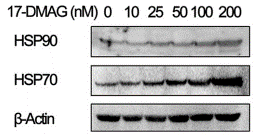
| Western blot | HSP90 / HSP70 p-Akt / Survivin / MMP2 PARP / Cleaved caspase-3 / Cleaved caspase-8 / Cleaved caspase-9 / PUMA p-ALK / ALK / p-Akt / Akt / p-ERK / ERK α-Tax / α-IKKα / α-IKKβ/ α-NEMO / α-TBK1 / α-p65 / α-p50 |
|
28915605 |
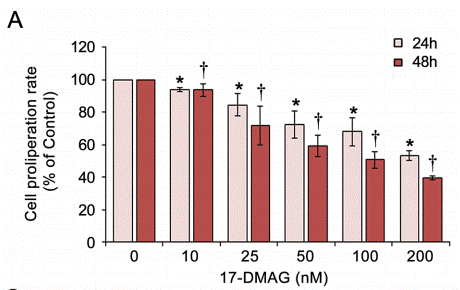
| Growth inhibition assay | Cell proliferation |
|
28915605 |
Informations sur l'essai clinique (Clinical Trial Information)
(données du https://clinicaltrials.gov, mis à jour le 2015-11-04)
| Numéro NCT | Recrutement | Conditions | Promoteur/Collaborateurs | Date de début | Phases |
|---|---|---|---|---|---|
| NCT01126502 | TERMINATED | B-cell Chronic Lymphocytic Leukemia; Prolymphocytic Leukemia; Recurrent Small Lymphocytic Lymphoma; Refractory Chronic Lymphocytic Leukemia |
National Cancer Institute (NCI) |
2010-05 | PHASE1 |
| NCT00089271 | COMPLETED | Anaplastic Large Cell Lymphoma; Angioimmunoblastic T-cell Lymphoma; Extranodal Marginal Zone B-cell Lymphoma of Mucosa-associated Lymphoid Tissue; Intraocular Lymphoma; Nodal Marginal Zone B-cell Lymphoma; Recurrent Adult Burkitt Lymphoma; Recurrent Adult Diffuse Large Cell Lymphoma; Recurrent Adult Diffuse Mixed Cell Lymphoma; Recurrent Adult Diffuse Small Cleaved Cell Lymphoma; Recurrent Adult Hodgkin Lymphoma; Recurrent Adult T-cell Leukemia/Lymphoma; Recurrent Cutaneous T-cell Non-Hodgkin Lymphoma; Recurrent Grade 1 Follicular Lymphoma; Recurrent Grade 2 Follicular Lymphoma; Recurrent Grade 3 Follicular Lymphoma; Recurrent Mantle Cell Lymphoma; Recurrent Marginal Zone Lymphoma; Recurrent Mycosis Fungoides/Sezary Syndrome; Recurrent Small Lymphocytic Lymphoma; Splenic Marginal Zone Lymphoma; Stage III Adult Burkitt Lymphoma; Stage III Adult Diffuse Large Cell Lymphoma; Stage III Adult Diffuse Mixed Cell Lymphoma; Stage III Adult Diffuse Small Cleaved Cell Lymphoma; Stage III Adult Hodgkin Lymphoma; Stage III Adult T-cell Leukemia/Lymphoma; Stage III Cutaneous T-cell Non-Hodgkin Lymphoma; Stage III Grade 1 Follicular Lymphoma; Stage III Grade 2 Follicular Lymphoma; Stage III Grade 3 Follicular Lymphoma; Stage III Mantle Cell Lymphoma; Stage III Marginal Zone Lymphoma; Stage III Mycosis Fungoides/Sezary Syndrome; Stage III Small Lymphocytic Lymphoma; Stage IV Adult Burkitt Lymphoma; Stage IV Adult Diffuse Large Cell Lymphoma; Stage IV Adult Diffuse Mixed Cell Lymphoma; Stage IV Adult Diffuse Small Cleaved Cell Lymphoma; Stage IV Adult Hodgkin Lymphoma; Stage IV Adult T-cell Leukemia/Lymphoma; Stage IV Cutaneous T-cell Non-Hodgkin Lymphoma; Stage IV Grade 1 Follicular Lymphoma; Stage IV Grade 2 Follicular Lymphoma; Stage IV Grade 3 Follicular Lymphoma; Stage IV Mantle Cell Lymphoma; Stage IV Marginal Zone Lymphoma; Stage IV Mycosis Fungoides/Sezary Syndrome; Stage IV Small Lymphocytic Lymphoma; Unspecified Adult Solid Tumor, Protocol Specific; Waldenström Macroglobulinemia |
National Cancer Institute (NCI) |
2004-07 | PHASE1 |
| NCT00088868 | COMPLETED | Lymphoma; Small Intestine Cancer; Unspecified Adult Solid Tumor, Protocol Specific |
National Institutes of Health Clinical Center (CC) |
2004-06 | PHASE1 |
| NCT00803556 | COMPLETED | Solid Tumor; Breast Cancer |
Bristol-Myers Squibb |
2006-01 | PHASE1 |
| NCT00780000 | TERMINATED | Breast Cancer |
Bristol-Myers Squibb |
2008-04 | PHASE2 |
| NCT00780000 | Terminated | Breast Cancer |
Bristol-Myers Squibb |
2008-04 | Phase 2 |

Les produits sont destinés à la recherche uniquement. Ne pas utiliser chez l'homme. Nous ne vendons pas aux patients.
©Copyright 2013 Selleck Chemicals. Tous droits réservés.