
pour la recherche uniquement
Eprenetapopt (APR-246) p53 Activateur
Réf. Catalogue: S7724
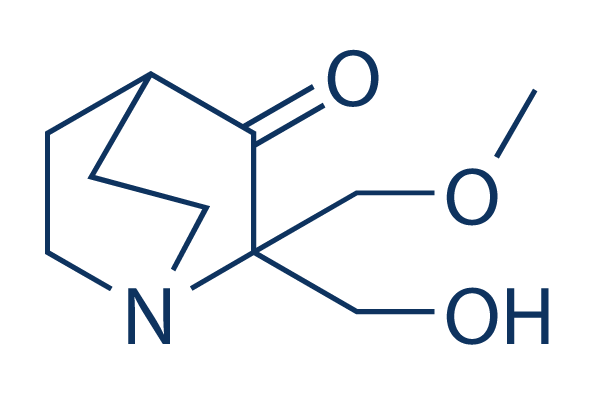
Structure chimique
Poids moléculaire: 199.25
Contrôle Qualité (Quality Control)
| Cibles apparentées | Bcl-2 Caspase PD-1/PD-L1 Ferroptosis Apoptosis related Synthetic Lethality STAT TNF-alpha Ras KRas |
|---|---|
| Autre p53 Inhibiteurs | CBL0137 Hydrochloride Pifithrin-α (PFTα) Hhydrobromide Pifithrin-μ RITA Serdemetan (JNJ-26854165) NSC 319726 (ZMC1) PRIMA-1 Tenovin-1 NSC59984 NSC348884 |
Culture cellulaire, traitement et concentration de travail
(Cell Culture, Treatment & Working Concentration)
| Lignées cellulaires | Type d'essai | Concentration | Temps d'incubation | Formulation | Description de l'activité | PMID |
|---|---|---|---|---|---|---|
| NALM-6 | Cell viability assay | high sensitivity and cell death induction in all TP53mut leukemias, but low APR-246 sensitivity in TP53wt ALL | 31073076 | |||
| UoCB-6 | Cell viability assay | high sensitivity and cell death induction in all TP53mut leukemias, but low APR-246 sensitivity in TP53wt ALL | 31073076 | |||
| EU-3 | Cell viability assay | high sensitivity and cell death induction in all TP53mut leukemias, but low APR-246 sensitivity in TP53wt ALL | 31073076 | |||
| MUTZ-5 | Cell viability assay | high sensitivity and cell death induction in all TP53mut leukemias, but low APR-246 sensitivity in TP53wt ALL | 31073076 | |||
| KOPN-8 | Cell viability assay | high sensitivity and cell death induction in all TP53mut leukemias, but low APR-246 sensitivity in TP53wt ALL | 31073076 | |||
| RS4;11 | Cell viability assay | high sensitivity and cell death induction in all TP53mut leukemias, but low APR-246 sensitivity in TP53wt ALL | 31073076 | |||
| SKBR3 | Cell cycle assay | 5 µM | 2 weeks | lapatinib in combination with APR-246 caused a lower level of G1 arrest and an increase in the sub-G1 fraction | 30743996 | |
| BT549 | Cell viability assay | IC50=3.1 μM | 30196236 | |||
| MDA-MB-468 | Cell viability assay | IC50=5 μM | 30196236 | |||
| MDA-MB-231 | Cell viability assay | IC50=4.1 μM | 30196236 | |||
| HCC1143 | Cell viability assay | IC50=6.8 μM | 30196236 | |||
| MDA-MB-453 | Cell viability assay | IC50=0.9 μM | 30196236 | |||
| SKBR3 | Cell viability assay | IC50=5.1 μM | 30196236 | |||
| UACC812 | Cell viability assay | IC50=11.3 μM | 30196236 | |||
| MCF7 | Cell viability assay | IC50=31.1 μM | 30196236 | |||
| MCF10A | Cell viability assay | IC50=5.2 μM | 30196236 | |||
| UMSCC10A | Cell viability assay | 0-50 μM | 72 h | suppressed cell survival and bore a modest effect on the killing of HNSCC cells | 29348462 | |
| FaDu | Cell viability assay | 0-50 μM | 72 h | suppressed cell survival and bore a modest effect on the killing of HNSCC cells | 29348462 | |
| TC32 | qHTS assay | qHTS of pediatric cancer cell lines to identify multiple opportunities for drug repurposing: Primary screen for TC32 cells | 29435139 | |||
| DAOY | qHTS assay | qHTS of pediatric cancer cell lines to identify multiple opportunities for drug repurposing: Primary screen for DAOY cells | 29435139 | |||
| SJ-GBM2 | qHTS assay | qHTS of pediatric cancer cell lines to identify multiple opportunities for drug repurposing: Primary screen for SJ-GBM2 cells | 29435139 | |||
| A673 | qHTS assay | qHTS of pediatric cancer cell lines to identify multiple opportunities for drug repurposing: Primary screen for A673 cells | 29435139 | |||
| SK-N-MC | qHTS assay | qHTS of pediatric cancer cell lines to identify multiple opportunities for drug repurposing: Primary screen for SK-N-MC cells | 29435139 | |||
| BT-37 | qHTS assay | qHTS of pediatric cancer cell lines to identify multiple opportunities for drug repurposing: Primary screen for BT-37 cells | 29435139 | |||
| NB-EBc1 | qHTS assay | qHTS of pediatric cancer cell lines to identify multiple opportunities for drug repurposing: Primary screen for NB-EBc1 cells | 29435139 | |||
| Saos-2 | qHTS assay | qHTS of pediatric cancer cell lines to identify multiple opportunities for drug repurposing: Primary screen for Saos-2 cells | 29435139 | |||
| SK-N-SH | qHTS assay | qHTS of pediatric cancer cell lines to identify multiple opportunities for drug repurposing: Primary screen for SK-N-SH cells | 29435139 | |||
| NB1643 | qHTS assay | qHTS of pediatric cancer cell lines to identify multiple opportunities for drug repurposing: Primary screen for NB1643 cells | 29435139 | |||
| LAN-5 | qHTS assay | qHTS of pediatric cancer cell lines to identify multiple opportunities for drug repurposing: Primary screen for LAN-5 cells | 29435139 | |||
| BT-12 | qHTS assay | qHTS of pediatric cancer cell lines to identify multiple opportunities for drug repurposing: Primary screen for BT-12 cells | 29435139 | |||
| OHS-50 | qHTS assay | qHTS of pediatric cancer cell lines to identify multiple opportunities for drug repurposing: Primary screen for OHS-50 cells | 29435139 | |||
| MG 63 (6-TG R) | qHTS assay | qHTS of pediatric cancer cell lines to identify multiple opportunities for drug repurposing: Primary screen for MG 63 (6-TG R) cells | 29435139 | |||
| Rh41 | qHTS assay | qHTS of pediatric cancer cell lines to identify multiple opportunities for drug repurposing: Primary screen for Rh41 cells | 29435139 | |||
| Cliquez pour voir plus de données expérimentales sur la lignée cellulaire | ||||||
Informations chimiques, stockage et stabilité (Chemical Information, Storage & Stability)
| Poids moléculaire | 199.25 | Formule | C10H17NO3 |
Stockage (À compter de la date de réception) | |
|---|---|---|---|---|---|
| N° CAS | 5291-32-7 | Télécharger le SDF | Stockage des solutions mères |
|
|
| Synonymes | PRIMA-1MET | Smiles | COCC1(C(=O)C2CCN1CC2)CO | ||
Solubilité (Solubility)
|
In vitro |
DMSO
: 40 mg/mL
(200.75 mM)
Water : 40 mg/mL Ethanol : 40 mg/mL |
Calculateur de molarité
|
In vivo |
|||||
Calculateur de formulation in vivo (Solution claire)
Étape 1 : Saisir les informations ci-dessous (Recommandé : Un animal supplémentaire pour tenir compte des pertes pendant l'expérience)
Étape 2 : Saisir la formulation in vivo (Ceci est seulement le calculateur, pas la formulation. Veuillez nous contacter d'abord s'il n'y a pas de formulation in vivo dans la section Solubilité.)
Résultats du calcul :
Concentration de travail : mg/ml;
Méthode de préparation du liquide maître DMSO : mg médicament prédissous dans μL DMSO ( Concentration du liquide maître mg/mL, Veuillez nous contacter d'abord si la concentration dépasse la solubilité du DMSO du lot de médicament. )
Méthode de préparation de la formulation in vivo : Prendre μL DMSO liquide maître, puis ajouterμL PEG300, mélanger et clarifier, puis ajouterμL Tween 80, mélanger et clarifier, puis ajouter μL ddH2O, mélanger et clarifier.
Méthode de préparation de la formulation in vivo : Prendre μL DMSO liquide maître, puis ajouter μL Huile de maïs, mélanger et clarifier.
Note : 1. Veuillez vous assurer que le liquide est clair avant d'ajouter le solvant suivant.
2. Assurez-vous d'ajouter le(s) solvant(s) dans l'ordre. Vous devez vous assurer que la solution obtenue, lors de l'ajout précédent, est une solution claire avant de procéder à l'ajout du solvant suivant. Des méthodes physiques telles que le vortex, les ultrasons ou le bain-marie chaud peuvent être utilisées pour faciliter la dissolution.
Mécanisme d'action (Mechanism of Action)
| Targets/IC50/Ki |
Mutant p53
|
|---|---|
| In vitro |
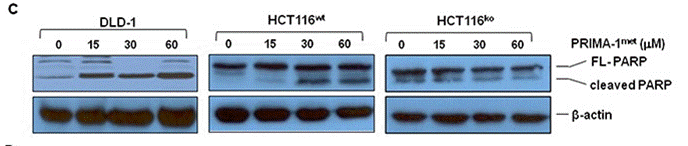
Eprenetapopt (APR-246), also known as PRIMA-1MET, is the first clinical-stage compound that reactivates mutant p53 and induces apoptosis. It is a prodrug that is converted to the active compound methylene quinuclidinone (MQ), a Michael acceptor that binds to cysteine residues in mutant p53 and restores its wild-type conformation. This compound not only reactivates p53 but also decreases intracellular glutathione levels in a dose-dependent manner. It can trigger apoptosis in a p53-independent manner by inducing ROS and endoplasmic reticulum (ER) stress and by inhibiting thioredoxin reductase 1 (TrxR1). It was also reported that APR-246 induces cell death in myeloma cells independently of p53 status by impairing the GSH/ROS balance. PRIMA-1Met/APR-246 efficiently inhibited the growth of the SCLC cell lines expressing mutant p53 in vitro and induced apoptosis, associated with increased fraction of cells with fragmented DNA, caspase-3 activation, PARP cleavage, Bax and Noxa upregulation and Bcl-2 downregulation in the cells. |
| In vivo |
In a Phase I/II clinical dose-finding study on hematological malignancies and prostate cancer, Eprenetapopt (APR-246) showed a good safety profile, and both clinical and p53-dependent biological responses were observed. It is well tolerated in animal studies, and single treatment with this compound inhibits tumor growth by 21% in mice bearing the aggressively growing A2780-CP20 tumor xenografts. |
Références |
|
Applications (Applications)
| Méthodes | Biomarqueurs | Images | PMID |
|---|---|---|---|
| Western blot | FL-PARP / Cleaved PARP p-p53 |
|
26452133 |
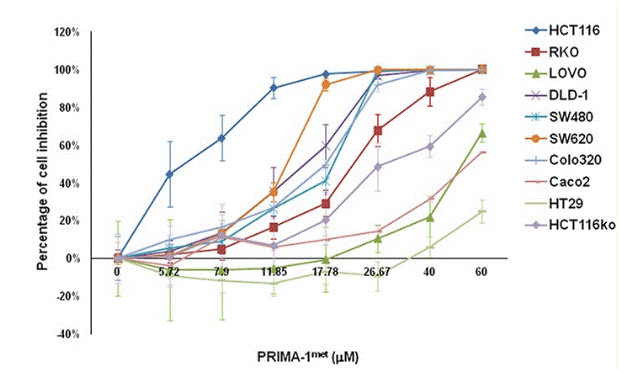
| Growth inhibition assay | Cell viability |
|
26452133 |
Informations sur l'essai clinique (Clinical Trial Information)
(données du https://clinicaltrials.gov, mis à jour le 2022-03-10)
| Numéro NCT | Recrutement | Conditions | Promoteur/Collaborateurs | Date de début | Phases |
|---|---|---|---|---|---|
| NCT04990778 | WITHDRAWN | Recurrent Mantle Cell Lymphoma; Refractory Mantle Cell Lymphoma |
M.D. Anderson Cancer Center |
2021-11-30 | PHASE2 |
| NCT04383938 | COMPLETED | Bladder Cancer; Gastric Cancer; Non Small Cell Lung Cancer; NSCLC; Urothelial Carcinoma; Advanced Solid Tumor |
Aprea Therapeutics |
2020-06-25 | PHASE1; PHASE2 |
| NCT04214860 | COMPLETED | Myeloid Malignancy |
Aprea Therapeutics |
2019-12-13 | PHASE1 |
| NCT03931291 | COMPLETED | Acute Myeloid Leukemia or Myelodysplastic Syndromes |
Aprea Therapeutics |
2019-09-16 | PHASE2 |
| NCT04419389 | TERMINATED | Non Hodgkin Lymphoma; Chronic Lymphocytic Leukemia; Mantle Cell Lymphoma |
Aprea Therapeutics |
2021-03-02 | PHASE1; PHASE2 |
| NCT03745716 | COMPLETED | MDS |
Aprea Therapeutics |
2019-01-11 | PHASE3 |

Les produits sont destinés à la recherche uniquement. Ne pas utiliser chez l'homme. Nous ne vendons pas aux patients.
©Copyright 2013 Selleck Chemicals. Tous droits réservés.