
pour la recherche uniquement
CBL0137 Hydrochloride p53 activateur
Réf. CatalogueS8483
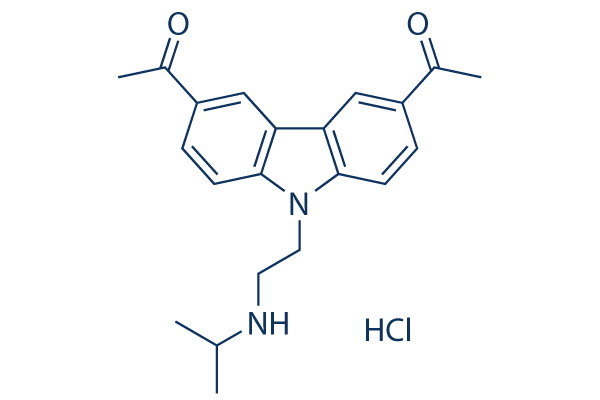
Structure chimique
Poids moléculaire: 372.89
Contrôle Qualité
| Cibles apparentées | Bcl-2 Caspase PD-1/PD-L1 Ferroptosis Apoptosis related Synthetic Lethality STAT TNF-alpha Ras KRas |
|---|---|
| Autre p53 Inhibiteurs | Eprenetapopt (APR-246) Pifithrin-α (PFTα) Hhydrobromide Pifithrin-μ Serdemetan (JNJ-26854165) RITA PRIMA-1 NSC 319726 (ZMC1) NSC348884 Tenovin-6 Tenovin-1 |
Informations chimiques, stockage et stabilité
| Poids moléculaire | 372.89 | Formule | C21H24N2O2.HCl |
Stockage (À compter de la date de réception) | |
|---|---|---|---|---|---|
| N° CAS | 1197397-89-9 | Télécharger le SDF | Stockage des solutions mères |
|
|
| Synonymes | CBLC137 HCl, Curaxin 137 HCl | Smiles | CC(C)NCCN1C2=C(C=C(C=C2)C(=O)C)C3=C1C=CC(=C3)C(=O)C.Cl | ||
Solubilité
|
In vitro |
DMSO
: 20 mg/mL
(53.63 mM)
Water : 20 mg/mL Ethanol : Insoluble |
Calculateur de molarité
|
In vivo |
|||||
Calculateur de formulation in vivo (Solution claire)
Étape 1 : Saisir les informations ci-dessous (Recommandé : Un animal supplémentaire pour tenir compte des pertes pendant lexpérience)
Étape 2 : Saisir la formulation in vivo (Ceci est seulement le calculateur, pas la formulation. Veuillez nous contacter dabord sil ny a pas de formulation in vivo dans la section Solubilité.)
Résultats du calcul :
Concentration de travail : mg/ml;
Méthode de préparation du liquide maître DMSO : mg médicament prédissous dans μL DMSO ( Concentration du liquide maître mg/mL, Veuillez nous contacter dabord si la concentration dépasse la solubilité du DMSO du lot de médicament. )
Méthode de préparation de la formulation in vivo : Prendre μL DMSO liquide maître, puis ajouterμL PEG300, mélanger et clarifier, puis ajouterμL Tween 80, mélanger et clarifier, puis ajouter μL ddH2O, mélanger et clarifier.
Méthode de préparation de la formulation in vivo : Prendre μL DMSO liquide maître, puis ajouter μL Huile de maïs, mélanger et clarifier.
Note : 1. Veuillez vous assurer que le liquide est clair avant dajouter le solvant suivant.
2. Assurez-vous dajouter le(s) solvant(s) dans lordre. Vous devez vous assurer que la solution obtenue, lors de lajout précédent, est une solution claire avant de procéder à lajout du solvant suivant. Des méthodes physiques telles que le vortex, les ultrasons ou le bain-marie chaud peuvent être utilisées pour faciliter la dissolution.
Mécanisme daction
| Targets/IC50/Ki |
FACT
p53
(Cell-free assay) 0.37 μM(EC50)
NF-κB
(Cell-free assay) 0.47 μM(EC50)
|
|---|---|
| In vitro |
CBL0137 est un puissant inducteur de l'apoptose dans les lignées cellulaires de cancer du pancréas et est toxique non seulement pour les cellules tumorales proliférantes, mais aussi pour les cellules souches du cancer du pancréas. CBL0137 et les molécules apparentées peuvent activer simultanément p53 et inhiber les voies de stress cellulaire médiées par NF-κB et HSF-1. CBL0137 se lie à l'ADN mais ne provoque aucune sorte de modifications chimiques de l'ADN et est donc dépourvu de génotoxicité. Cependant, la liaison de CBL0137 à l'ADN entraîne l'inactivation fonctionnelle du complexe Facilitates Chromatin Transcription (FACT), un complexe de remodelage de la chromatine impliqué dans la transcription, la réplication et la réparation de l'ADN. Dans les cellules traitées par CBL0137, FACT est perdu du nucléoplasme et piégé dans la chromatine, ce qui entraîne l'inhibition de la transcription dépendante de FACT, y compris la transcription médiée par NF-kB. De plus, le piégeage de FACT dans la chromatine conduit à la phosphorylation et à l'activation de p53 dépendantes de la caséine kinase 2 (CK2). |
| In vivo |
Chez la souris, CBL0137 est efficace contre plusieurs modèles d'adénocarcinome canalaire pancréatique (PDA), y compris les xénogreffes dérivées de patients, où l'effet anti-tumoral de CBL0137 est corrélé à la surexpression de FACT. CBL0137 cible le glioblastome (GBM) selon son mécanisme d'action proposé, traverse la barrière hémato-encéphalique et est efficace dans les modèles orthotopiques sensibles et résistants au TMZ. La propriété de traverser la barrière hémato-encéphalique, en particulier lorsqu'il est administré par voie intraveineuse, est de bon augure pour le potentiel de ce médicament à traiter les tumeurs du SNC. Dans les modèles orthotopiques, l'administration intraveineuse entraîne une plus grande accumulation tissulaire tumorale que l'administration orale, ce qui conduit à une plus grande biodisponibilité. L'accumulation de CBL0137 dans le tissu cérébral normal ne provoque aucune neurotoxicité observable. |
Références |
|
Applications
| Méthodes | Biomarqueurs | Images | PMID |
|---|---|---|---|
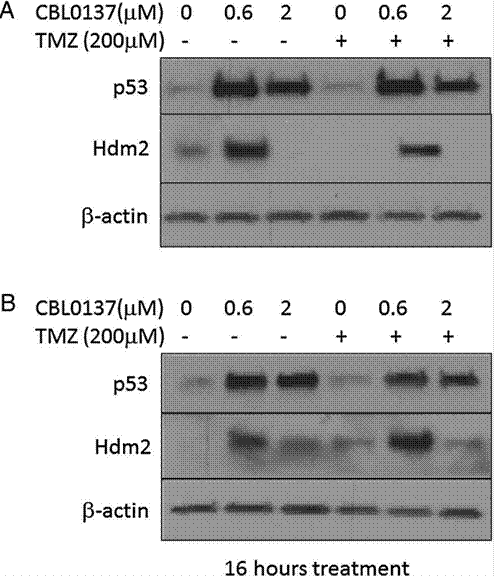
| Western blot | p53 / Hdm2 caspase-3 / caspase-7 / caspase-8 / caspase-9 / PARP |
|
27370399 |
Support technique
Tel: +1-832-582-8158 Ext:3
Si vous avez dautres questions, veuillez laisser un message.

Les produits sont destinés à la recherche uniquement. Ne pas utiliser chez lhomme. Nous ne vendons pas aux patients.
©Copyright 2013 Selleck Chemicals. Tous droits réservés.