
pour la recherche uniquement
IPI-145 (Duvelisib) PI3K δ/γ Inhibiteur
Réf. CatalogueS7028
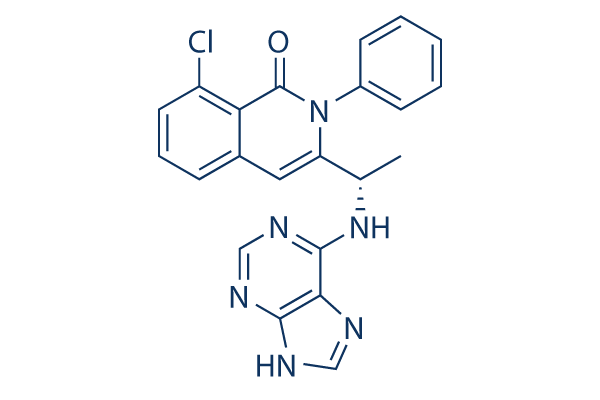
Structure chimique
Poids moléculaire: 416.86
Contrôle Qualité
| Cibles apparentées | EGFR VEGFR JAK PDGFR FGFR Src HIF FLT FLT3 HER2 |
|---|---|
| Autre PI3K Inhibiteurs | GDC-0077 (Inavolisib) SAR405 Quercetin (Sophoretin) LY294002 XL147 analogue Tersolisib (STX-478) Buparlisib (BKM120) 740 Y-P (PDGFR 740Y-P) GO-203 TFA Eganelisib (IPI-549) |
Culture cellulaire, traitement et concentration de travail
| Lignées cellulaires | Type dessai | Concentration | Temps dincubation | Formulation | Description de lactivité | PMID |
|---|---|---|---|---|---|---|
| Jurkat | Proliferation assay | 3 days | Antiproliferative activity against human Jurkat cells after 3 days by CellTiter-Glo assay, IC50=1.9 Μm | 27774127 | ||
| MOLT4 | Proliferation assay | 3 days | Antiproliferative activity against human MOLT4 cells after 3 days by CellTiter-Glo assay, IC50=2.3 μM | 27774127 | ||
| MV4-11 | Proliferation assay | 3 days | Antiproliferative activity against human MV4-11 cells after 3 days by CellTiter-Glo assay, IC50=4.4 μM | 27774127 | ||
| MOLM14 | Proliferation assay | 3 days | Antiproliferative activity against human MOLM14 cells after 3 days by CellTiter-Glo assay, IC50=1.2 μM | 27774127 | ||
| Loucy | Proliferation assay | 3 days | Antiproliferative activity against human Loucy cells after 3 days by CellTiter-Glo assay, IC50=0.98 μM | 27774127 | ||
| JURKAT | Function assay | 0.1, 1.0, and 9.0 μM | IPI145 was able to inhibit Akt and S6 phosphorylation and modestly affected growth in JURKAT | 30970263 | ||
| MOLT3 | Function assay | 0.1, 1.0, and 9.0 μM | IPI145 was able to inhibit Akt and S6 phosphorylation but barely affected the growth of MOLT3 T-ALL | 30970263 | ||
| Raji32 | Function assay | 1 μM | effectively impaired the phosphorylation of Akt | 30584254 | ||
| Ramos460 | Function assay | 1 μM | effectively impaired the phosphorylation of Akt | 30584254 | ||
| HBL-1 | Growth inhibition assay | GI50=5.3 μM | 30067771 | |||
| OCI-Ly3 | Growth inhibition assay | GI50=3.7 μM | 30067771 | |||
| TMD-8 | Growth inhibition assay | GI50=0.0005 μM | 30067771 | |||
| U-2932 | Growth inhibition assay | GI50=1.8 μM | 30067771 | |||
| Farage | Growth inhibition assay | GI50=0.04 μM | 30067771 | |||
| SU-DHL-10 | Growth inhibition assay | GI50=2.4 μM | 30067771 | |||
| SU-DHL-4 | Growth inhibition assay | GI50=0.2 μM | 30067771 | |||
| Karpas-422 | Growth inhibition assay | GI50=0.1 μM | 30067771 | |||
| DOHH-2 | Growth inhibition assay | GI50=0.05 μM | 30067771 | |||
| WSU-NHL | Growth inhibition assay | GI50=0.008 μM | 30067771 | |||
| Jeko-1 | Growth inhibition assay | GI50=1.3 μM | 30067771 | |||
| Mino | Growth inhibition assay | GI50=3.4 μM | 30067771 | |||
| NCI-H929 | Growth inhibition assay | GI50=1 μM | 30067771 | |||
| HH | Growth inhibition assay | GI50=0.01 μM | 30067771 | |||
| BJAB | Cell viability assay | 0.1, 1, 5 μM | 48 and 72 h | inhibited cell growth | 29522278 | |
| LCL | Cell viability assay | 0.1, 1, 5 μM | 48 and 72 h | inhibited cell growth | 29522278 | |
| insect cells | Function assay | 5 mins | Inhibition of recombinant human C-terminal His6-tagged p110gamma expressed in insect cells using phosphatidylinositol as substrate in presence of gamma-32P-ATP after 5 mins by thin layer chromatographic method, IC50 = 0.1 μM. | ChEMBL | ||
| Sf21 | Function assay | 5 mins | Inhibition of N-terminal His6-tagged recombinant full-length human p110delta/untagged recombinant full length p85alpha expressed in baculovirus infected Sf21 cells using phosphatidylinositol as substrate in presence of gamma-32P-ATP after 5 mins by thin l, IC50 = 0.1 μM. | ChEMBL | ||
| splenic B | Antiproliferative assay | 30 mins | Antiproliferative activity against Balb/c mouse splenic B cells preincubated for 30 mins followed by LPS or F(ab')2 donkey anti-mouse IgM and recombinant mouse IL4 stimulation measured after 72 hrs by Alamar Blue reduction assay, EC50 = 0.1 μM. | ChEMBL | ||
| Sf21 | Function assay | 5 mins | Inhibition of N-terminal His6-tagged recombinant full-length human p110beta/untagged recombinant full length p85alpha expressed in baculovirus infected Sf21 cells using phosphatidylinositol as substrate in presence of gamma-32P-ATP after 5 mins by thin la, IC50 = 1 μM. | ChEMBL | ||
| Sf21 | Function assay | 5 mins | Inhibition of N-terminal His6-tagged recombinant full-length human p110alpha/untagged recombinant full length human p85alpha expressed in baculovirus infected Sf21 cells using phosphatidylinositol as substrate in presence of gamma-32P-ATP after 5 mins by , IC50 = 10 μM. | ChEMBL | ||
| Cliquez pour voir plus de données expérimentales sur la lignée cellulaire | ||||||
Informations chimiques, stockage et stabilité
| Poids moléculaire | 416.86 | Formule | C22H17ClN6O |
Stockage (À compter de la date de réception) | |
|---|---|---|---|---|---|
| N° CAS | 1201438-56-3 | Télécharger le SDF | Stockage des solutions mères |
|
|
| Synonymes | INK1197 | Smiles | CC(C1=CC2=C(C(=CC=C2)Cl)C(=O)N1C3=CC=CC=C3)NC4=NC=NC5=C4NC=N5 | ||
Solubilité
|
In vitro |
DMSO
: 83 mg/mL
(199.1 mM)
Water : Insoluble Ethanol : Insoluble |
Calculateur de molarité
|
In vivo |
|||||
Calculateur de formulation in vivo (Solution claire)
Étape 1 : Saisir les informations ci-dessous (Recommandé : Un animal supplémentaire pour tenir compte des pertes pendant lexpérience)
Étape 2 : Saisir la formulation in vivo (Ceci est seulement le calculateur, pas la formulation. Veuillez nous contacter dabord sil ny a pas de formulation in vivo dans la section Solubilité.)
Résultats du calcul :
Concentration de travail : mg/ml;
Méthode de préparation du liquide maître DMSO : mg médicament prédissous dans μL DMSO ( Concentration du liquide maître mg/mL, Veuillez nous contacter dabord si la concentration dépasse la solubilité du DMSO du lot de médicament. )
Méthode de préparation de la formulation in vivo : Prendre μL DMSO liquide maître, puis ajouterμL PEG300, mélanger et clarifier, puis ajouterμL Tween 80, mélanger et clarifier, puis ajouter μL ddH2O, mélanger et clarifier.
Méthode de préparation de la formulation in vivo : Prendre μL DMSO liquide maître, puis ajouter μL Huile de maïs, mélanger et clarifier.
Note : 1. Veuillez vous assurer que le liquide est clair avant dajouter le solvant suivant.
2. Assurez-vous dajouter le(s) solvant(s) dans lordre. Vous devez vous assurer que la solution obtenue, lors de lajout précédent, est une solution claire avant de procéder à lajout du solvant suivant. Des méthodes physiques telles que le vortex, les ultrasons ou le bain-marie chaud peuvent être utilisées pour faciliter la dissolution.
Mécanisme daction
| Targets/IC50/Ki |
PI3Kδ
(Cell-free assay) 23 pM(Ki)
PI3Kβ
(Cell-free assay) 1564 pM(Ki)
PI3Kγ
(Cell-free assay) 243 pM(Ki)
|
|---|---|
| In vitro |
Duvelisib (IPI-145) supprime la prolifération des lymphocytes B murins/humains avec une EC50 de 0,5 nM/0,5 nM et inhibe également la prolifération des lymphocytes T humains avec une EC50 de 9,5 nM. |
| In vivo |
Le Duvelisib (IPI-145) (10 mg/kg, p.o.) montre une bonne pharmacocinétique avec des Cmax et AUC de 390 ng/mL et 137 ng•h/mL chez la souris et le rat. Il est actif dans le modèle DTH murin avec ~50 % d'œdème de l'oreille et démontre un effet dose-dépendant dans le modèle d'arthrite induite par le collagène (CIA) chez le rat. Ce composé prévient l'inflammation et protège l'os et le cartilage articulaire dans le modèle CIA chez le rat. Il (10 mg/kg, QD) démontre également une activité dans le modèle de polyarthrite induite par l'adjuvant chez le rat. |
Références |
|
Applications
| Méthodes | Biomarqueurs | Images | PMID |
|---|---|---|---|
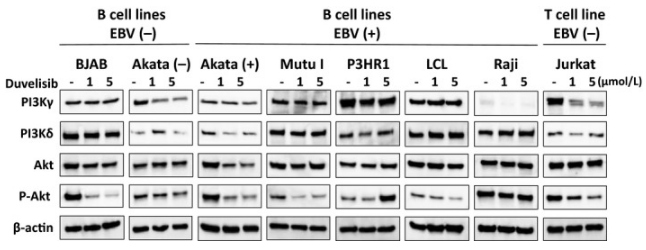
| Western blot | PI3Kγ / PI3Kδ p-AKT / AKT / p-MAPK / MAPK |
|
29522278 |
Informations sur lessai clinique
(données du https://clinicaltrials.gov, mis à jour le 2024-05-22)
| Numéro NCT | Recrutement | Conditions | Promoteur/Collaborateurs | Date de début | Phases |
|---|---|---|---|---|---|
| NCT02307461 | Completed | Healthy |
SecuraBio |
November 2014 | Phase 1 |
| NCT02095587 | Completed | Hepatic Impairment |
SecuraBio |
March 2014 | Phase 1 |
| NCT01947777 | Completed | Healthy |
SecuraBio |
October 2013 | Phase 1 |
| NCT01925911 | Completed | Healthy |
SecuraBio |
August 2013 | Phase 1 |
| NCT01836861 | Completed | Healthy |
SecuraBio |
March 2013 | Phase 1 |
| NCT01549106 | Completed | Healthy Volunteers |
SecuraBio |
August 2011 | Phase 1 |
Support technique
Tel: +1-832-582-8158 Ext:3
Si vous avez dautres questions, veuillez laisser un message.
Foire aux questions
Question 1:
Whether it is a mixture of two chiral forms, and if not, which form is this compound?
Réponse :
Its S form is S7028.

Les produits sont destinés à la recherche uniquement. Ne pas utiliser chez lhomme. Nous ne vendons pas aux patients.
©Copyright 2013 Selleck Chemicals. Tous droits réservés.