
pour la recherche uniquement
GSK429286A ROCK inhibiteur
Réf. CatalogueS1474
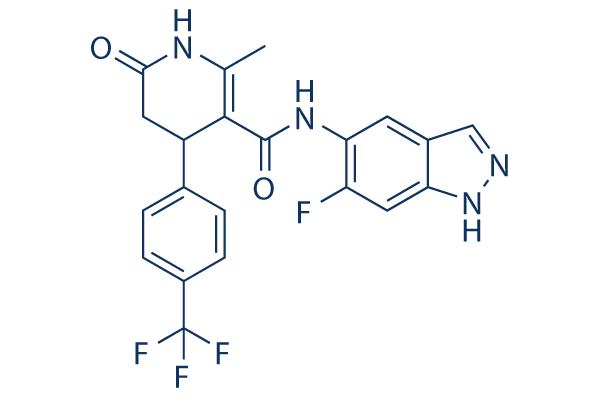
Structure chimique
Poids moléculaire: 432.37
Contrôle Qualité
Culture cellulaire, traitement et concentration de travail
| Lignées cellulaires | Type dessai | Concentration | Temps dincubation | Formulation | Description de lactivité | PMID |
|---|---|---|---|---|---|---|
| Sf9 cells | Function assay | Inhibition of human recombinant ROCK1 expressed in Sf9 cells at 10 mM, IC50=0.014 μM | 17201405 | |||
| Cliquez pour voir plus de données expérimentales sur la lignée cellulaire | ||||||
Informations chimiques, stockage et stabilité
| Poids moléculaire | 432.37 | Formule | C21H16F4N4O2 |
Stockage (À compter de la date de réception) | |
|---|---|---|---|---|---|
| N° CAS | 864082-47-3 | Télécharger le SDF | Stockage des solutions mères |
|
|
| Synonymes | RHO-15 | Smiles | CC1=C(C(CC(=O)N1)C2=CC=C(C=C2)C(F)(F)F)C(=O)NC3=C(C=C4C(=C3)C=NN4)F | ||
Solubilité
|
In vitro |
DMSO
: 86 mg/mL
(198.9 mM)
Ethanol : 5 mg/mL Water : Insoluble |
Calculateur de molarité
|
In vivo |
|||||
Calculateur de formulation in vivo (Solution claire)
Étape 1 : Saisir les informations ci-dessous (Recommandé : Un animal supplémentaire pour tenir compte des pertes pendant lexpérience)
Étape 2 : Saisir la formulation in vivo (Ceci est seulement le calculateur, pas la formulation. Veuillez nous contacter dabord sil ny a pas de formulation in vivo dans la section Solubilité.)
Résultats du calcul :
Concentration de travail : mg/ml;
Méthode de préparation du liquide maître DMSO : mg médicament prédissous dans μL DMSO ( Concentration du liquide maître mg/mL, Veuillez nous contacter dabord si la concentration dépasse la solubilité du DMSO du lot de médicament. )
Méthode de préparation de la formulation in vivo : Prendre μL DMSO liquide maître, puis ajouterμL PEG300, mélanger et clarifier, puis ajouterμL Tween 80, mélanger et clarifier, puis ajouter μL ddH2O, mélanger et clarifier.
Méthode de préparation de la formulation in vivo : Prendre μL DMSO liquide maître, puis ajouter μL Huile de maïs, mélanger et clarifier.
Note : 1. Veuillez vous assurer que le liquide est clair avant dajouter le solvant suivant.
2. Assurez-vous dajouter le(s) solvant(s) dans lordre. Vous devez vous assurer que la solution obtenue, lors de lajout précédent, est une solution claire avant de procéder à lajout du solvant suivant. Des méthodes physiques telles que le vortex, les ultrasons ou le bain-marie chaud peuvent être utilisées pour faciliter la dissolution.
Mécanisme daction
| Caractéristiques |
Greater selectivity than Y-27632.
|
|---|---|
| Targets/IC50/Ki |
ROCK1
(Cell-free assay) 14 nM
ROCK2
(Cell-free assay) 63 nM
|
| In vitro |
GSK429286A inhibe légèrement RSK et p70S6K avec une IC50 de 0,78 μM et 1,94 μM, respectivement. Ce composé inhibe de manière significative la dilatation de l'anneau aortique de rat avec une IC50 de 190 nM. Ce produit chimique à 1 μM réduit l'activité de ROCK2 de plus de 20 fois, dans des conditions où la seule autre kinase testée qui est significativement inhibée est MSK1 dont l'activité est réduite d'environ 5 fois. C'est un inhibiteur plus sélectif de ROCK2 que l'inhibiteur de ROCK largement utilisé Y-27632, tel qu'évalué sur un panel de spécificité de kinase, et n'inhibe pas significativement LRRK2 même à des doses aussi élevées que 30 μM (500 fois plus élevées que l'IC50 d'inhibition de ROCK2). Comme le GSK269962A mais pas le sunitinib, ce traitement par composé à 10 μM annule la phosphorylation basale ou induite par le mutant G14V-Rho de MYPT à Thr850 dans les cellules HEK-293 dans une mesure similaire à H-1152 et Y-27632, ce qui est cohérent avec la médiation de cette phosphorylation par ROCK, tandis qu'il n'inhibe pas la phosphorylation des protéines ERM en présence ou en absence de G14V-Rho.
|
| In vivo |
GSK429286A a une biodisponibilité orale de 61 % chez les rats Sprague-Dawley mâles. L'administration orale de ce composé à des doses uniques de 3 à 30 mg/kg réduit considérablement la pression artérielle moyenne chez les rats spontanément hypertendus (SHR) de manière dose-dépendante, avec une diminution maximale de 50 mmHg après environ 2 heures de traitement à une dose de 30 mg/kg.
|
Références |
|
Support technique
Tel: +1-832-582-8158 Ext:3
Si vous avez dautres questions, veuillez laisser un message.
Foire aux questions
Question 1:
The product sold by Selleckchem has an “A” at the end. I am wondering if it is the same compound as GSK429286?
Réponse :
For the compound GSK429286 and this compound, they are the same and have an identical CAS# (864082-47-3). Attached please find the reference about it, which was published by GSK, and the link is followed: http://www.ncbi.nlm.nih.gov/pubmed/19740074.

Les produits sont destinés à la recherche uniquement. Ne pas utiliser chez lhomme. Nous ne vendons pas aux patients.
©Copyright 2013 Selleck Chemicals. Tous droits réservés.