
pour la recherche uniquement
Abemaciclib (LY2835219) inhibiteur de CDK4/6
Réf. CatalogueS5716
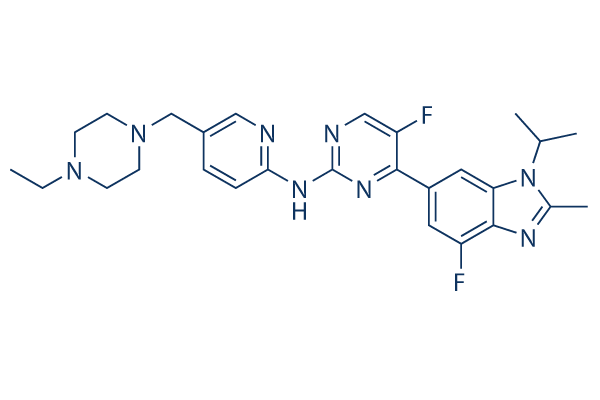
Structure chimique
Poids moléculaire: 506.59
Contrôle Qualité
Culture cellulaire, traitement et concentration de travail
| Lignées cellulaires | Type dessai | Concentration | Temps dincubation | Formulation | Description de lactivité | PMID |
|---|---|---|---|---|---|---|
| COLO205 cells | Function assay | 24 h | Inhibition of CDK4/6 in human COLO205 cells assessed as inhibition of Rb phosphorylation after 24 hrs by propidium iodide staining-based laser-scanning fluorescence microplate cytometric analysis, IC50=0.12 μM | 26115571 | ||
| SK-ES-1 | Proliferation assay | 96 hours | antiproliferative effects with an absolute EC50 value below 1 μmol/L | 30131386 | ||
| Cado-ES-1 | Proliferation assay | 96 hours | antiproliferative effects with an absolute EC50 value below 1 μmol/L | 30131386 | ||
| ES-7 | Proliferation assay | 96 hours | antiproliferative effects with an absolute EC50 value below 1 μmol/L | 30131386 | ||
| TC-71 | Proliferation assay | 96 hours | antiproliferative effects with an absolute EC50 value below 1 μmol/L | 30131386 | ||
| A673 | Proliferation assay | 96 hours | antiproliferative effects with an absolute EC50 value below 1 μmol/L | 30131386 | ||
| RD-ES | Proliferation assay | 96 hours | antiproliferative effects with an absolute EC50 value below 1 μmol/L | 30131386 | ||
| ES-1 | Proliferation assay | 96 hours | antiproliferative effects with an absolute EC50 value below 1 μmol/L | 30131386 | ||
| ES-3 | Proliferation assay | 96 hours | antiproliferative effects with an absolute EC50 value below 1 μmol/L | 30131386 | ||
| CHLA-258 | Proliferation assay | 96 hours | antiproliferative effects with an absolute EC50 value below 1 μmol/L | 30131386 | ||
| MHH-ES-1 | Proliferation assay | 96 hours | antiproliferative effects with an absolute EC50 value below 1 μmol/L | 30131386 | ||
| ES-8 | Proliferation assay | 96 hours | antiproliferative effects with an absolute EC50 value below 1 μmol/L | 30131386 | ||
| EW8 | Proliferation assay | 96 hours | antiproliferative effects with an absolute EC50 value below 1 μmol/L | 30131386 | ||
| ES-6 | Proliferation assay | 96 hours | antiproliferative effects with an absolute EC50 value below 1 μmol/L | 30131386 | ||
| ES-2 | Proliferation assay | 96 hours | antiproliferative effects with an absolute EC50 value below 1 μmol/L | 30131386 | ||
| SMS-CTR | Proliferation assay | 96 hours | antiproliferative effects with an absolute EC50 value below 1 μmol/L | 30131386 | ||
| ES-4 | Proliferation assay | 96 hours | antiproliferative effects with an absolute EC50 value below 1 μmol/L | 30131386 | ||
| CT26 | Cell viability assay | 96 hours | IC50=2.7 μM | 29539425 | ||
| insect cells | Function assay | 50 mins | Competitive inhibition of human CDK4/cyclin D1 expressed in insect cells assessed as phosphorylation of CTRF after 50 mins by Michaelis-Menten plot analysis in presence of ATP, Ki = 0.0006 μM. | 26115571 | ||
| insect cells | Function assay | 50 mins | Inhibition of human CDK4/cyclin D1 expressed in insect cells assessed as phosphorylation of CTRF after 50 mins by microplate scintillation counter, IC50 = 0.002 μM. | 26115571 | ||
| COLO205 | Function assay | 24 hrs | Inhibition of CDK4/6 in human COLO205 cells assessed as maximum cell cycle arrest at G1 phase after 24 hrs by propidium iodide staining-based flow cytometric analysis, INH = 6.7 μM. | 26115571 | ||
| Sf9 | Function assay | Inhibition of CDK1/Cyclin B (unknown origin) expressed in baculoviral infected insect Sf9 cells using histone H1 as substrate in presence of [gamma-33P]ATP, IC50 = 0.371 μM. | 26741853 | |||
| Sf9 | Function assay | 90 mins | Inhibition of recombinant human N-terminal GST-tagged CDK4 (4 to 303 residues)/cyclin D1 (4 to 295 residues) expressed in sf9 cells using C-terminal retinoblastoma fragment as substrate after 90 mins by [gamma-33P]ATP based microbeta scintillation countin, Ki = 0.002 μM. | 27171036 | ||
| Sf9 | Function assay | 90 mins | Inhibition of recombinant full length human N-terminal GST-tagged CDK6 (1 to 326 residues)/cyclin D1 (4 to 295 residues) expressed in sf9 cells using C-terminal retinoblastoma fragment as substrate after 90 mins by [gamma-33P]ATP based microbeta scintilla, Ki = 0.01 μM. | 27171036 | ||
| Sf21 | Function assay | Inhibition of recombinant human full length C-terminal His6-tagged CDK7/cyclin H/N-terminal GST-tagged MAT1 expressed in baculovirus infected Sf21 insect cells using cdk7 substrate peptide, Ki = 3.91 μM. | 27171036 | |||
| COLO205 | Antiproliferative assay | 96 hrs | Antiproliferative activity against human COLO205 cells after 96 hrs by CCK-8 assay, IC50 = 0.46 μM. | 29074254 | ||
| U87MG | Antiproliferative assay | 72 hrs | Antiproliferative activity against human U87MG cells after 72 hrs by DAPI staining based assay, IC50 = 0.0481 μM. | 29247857 | ||
| Sf9 | Function assay | Inhibition of recombinant human N-terminal GST-tagged CDK4 (S4 to E303 residues)/Cyclin D1 (Q4 to I295 residues) expressed in sf9 cells using Rb protein (773 to 928 residues) as substrate in presence of [33P]-ATP by scintillation counting method, IC50 = 0.002 μM. | 29429832 | |||
| Sf9 | Function assay | 90 mins | Inhibition of recombinant human full length CDK6 expressed in baculovirus infected Sf9 insect cells using histone H1 substrate after 90 mins by ADP-Glo assay, IC50 = 0.0078 μM. | 29429832 | ||
| Sf9 | Function assay | Inhibition of recombinant human N-terminal GST-tagged CDK4 (M1 to A326 residues)/Cyclin D1 (Q4 to I295 residues) expressed in sf9 cells using Rb protein (773 to 928 residues) as substrate in presence of [33P]-ATP by scintillation counting method, IC50 = 0.01 μM. | 29429832 | |||
| Sf9 | Function assay | 90 mins | Inhibition of recombinant human full length CDK1/Cyclin D3 expressed in baculovirus infected Sf9 insect cells using histone H1 substrate after 90 mins by ADP-Glo assay, IC50 = 0.056 μM. | 29429832 | ||
| MDA-MB-231 | Antiproliferative assay | 72 hrs | Antiproliferative activity against human MDA-MB-231 cells after 72 hrs by DAPI staining based assay, IC50 = 0.191 μM. | 29429832 | ||
| COLO205 | Antiproliferative assay | 96 hrs | Antiproliferative activity against human COLO205 cells after 96 hrs by CCK8 assay, IC50 = 0.217 μM. | 29459274 | ||
| MDA-MB-468 | Antiproliferative assay | 96 hrs | Antiproliferative activity against human MDA-MB-468 cells after 96 hrs by CCK8 assay, IC50 = 4.808 μM. | 29459274 | ||
| COLO205 | Function assay | 0.1 to 10 uM | 24 hrs | Inhibition of CDK4 in human COLO205 cells assessed as reduction in total Rb protein level at 0.1 to 10 uM after 24 hrs by immunoblotting method | 29459274 | |
| COLO205 | Cell cycle arrest assay | up to 10 uM | 24 hrs | Cell cycle arrest in human COLO205 cells assessed as accumulation at G2/M phase up to 10 uM after 24 hrs by propidium iodide staining based FACS analysis | 29459274 | |
| Cliquez pour voir plus de données expérimentales sur la lignée cellulaire | ||||||
Informations chimiques, stockage et stabilité
| Poids moléculaire | 506.59 | Formule | C27H32F2N8 |
Stockage (À compter de la date de réception) | 3 years -20°C powder |
|---|---|---|---|---|---|
| N° CAS | 1231929-97-7 | -- | Stockage des solutions mères |
|
|
| Synonymes | LY2835219 | Smiles | CCN1CCN(CC1)CC2=CN=C(C=C2)NC3=NC=C(C(=N3)C4=CC5=C(C(=C4)F)N=C(N5C(C)C)C)F | ||
Solubilité
|
In vitro |
Ethanol : 8 mg/mL
DMSO
: 6 mg/mL
(11.84 mM)
Water : Insoluble |
Calculateur de molarité
|
In vivo |
|||||
Calculateur de formulation in vivo (Solution claire)
Étape 1 : Saisir les informations ci-dessous (Recommandé : Un animal supplémentaire pour tenir compte des pertes pendant lexpérience)
Étape 2 : Saisir la formulation in vivo (Ceci est seulement le calculateur, pas la formulation. Veuillez nous contacter dabord sil ny a pas de formulation in vivo dans la section Solubilité.)
Résultats du calcul :
Concentration de travail : mg/ml;
Méthode de préparation du liquide maître DMSO : mg médicament prédissous dans μL DMSO ( Concentration du liquide maître mg/mL, Veuillez nous contacter dabord si la concentration dépasse la solubilité du DMSO du lot de médicament. )
Méthode de préparation de la formulation in vivo : Prendre μL DMSO liquide maître, puis ajouterμL PEG300, mélanger et clarifier, puis ajouterμL Tween 80, mélanger et clarifier, puis ajouter μL ddH2O, mélanger et clarifier.
Méthode de préparation de la formulation in vivo : Prendre μL DMSO liquide maître, puis ajouter μL Huile de maïs, mélanger et clarifier.
Note : 1. Veuillez vous assurer que le liquide est clair avant dajouter le solvant suivant.
2. Assurez-vous dajouter le(s) solvant(s) dans lordre. Vous devez vous assurer que la solution obtenue, lors de lajout précédent, est une solution claire avant de procéder à lajout du solvant suivant. Des méthodes physiques telles que le vortex, les ultrasons ou le bain-marie chaud peuvent être utilisées pour faciliter la dissolution.
Mécanisme daction
| Targets/IC50/Ki |
CDK4
(Cell-free assay) 2 nM
CDK6
(Cell-free assay) 10 nM
|
|---|---|
| In vitro |
Abemaciclib inhibe de manière hautement sélective les complexes CDK4/cyclin D1 (IC50 = 2 nmol/L) et CDK6/cyclin D1 (IC50 = 10 nmol/L), sans activité contre d'autres complexes CDK/cyclin ou kinases liées au Cell Cycle dans les plages nanomolaires, à l'exception de l'inhibition de CDK9 à une IC50 au moins cinq fois plus élevée. Outre son activité dépendante du Cell Cycle, l'Abemaciclib est capable de stimuler l'immunité antitumorale en potentialisant la présentation des antigènes tumoraux et en supprimant sélectivement la prolifération des lymphocytes T régulateurs (Treg) en même temps. Conformément à son activité contre CDK4 et CDK6, l'Abemaciclib inhibe la phosphorylation de RB et conduit à un arrêt en phase G1 dans les lignées cellulaires compétentes pour RB. In vitro, le traitement par Abemaciclib a entraîné une activation accrue des cellules T humaines et une expression régulée à la hausse des gènes de présentation d'antigènes dans les cellules de cancer du sein MCF-7.
|
| In vivo |
Dans un modèle de xénogreffe de cancer colorectal utilisé pour développer un modèle pharmacocinétique/pharmacodynamique intégré, l'Abemaciclib peut être administré par voie orale selon un schéma continu pour obtenir une inhibition cible soutenue et démontre non seulement une inhibition durable du Cell Cycle, mais aussi une activité antitumorale en monothérapie. L'inhibition de la croissance tumorale est observée dans plusieurs autres modèles de xénogreffes de cancer humain, y compris ceux dérivés du cancer du poumon non à petites cellules (CPNPC), du mélanome, du glioblastome et du lymphome à cellules du manteau. L'Abemaciclib se distribue à travers la barrière hémato-encéphalique et prolonge la survie dans un modèle de xénogreffe de glioblastome intracrânien. Chez l'homme, la pharmacocinétique de l'Abemaciclib montre une phase d'absorption lente avec un temps médian de la dose orale à la concentration plasmatique maximale (tmax) allant de 4 à 6 heures. Il est largement éliminé et distribué. La demi-vie d'élimination terminale moyenne (t1/2) variait de 17,4 à 38,1 heures sans changement apparent dépendant de la dose dans la clairance.
|
Références |
|
Applications
| Méthodes | Biomarqueurs | Images | PMID |
|---|---|---|---|
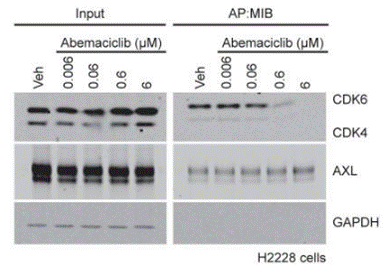
| Western blot | CDK6 / CDK4 / AXL GSK3β / CAMKII pan β-catenin p-Rb / Rb / p-EGFR / EGFR / p-HER2 / HER2 / p-HER3 / HER3 / p-P70S6K / P70S6K / p-S6RP / S6RP / Cyclin D1 |
|
29133594 |
Informations sur lessai clinique
(données du https://clinicaltrials.gov, mis à jour le 2024-05-22)
| Numéro NCT | Recrutement | Conditions | Promoteur/Collaborateurs | Date de début | Phases |
|---|---|---|---|---|---|
| NCT06139107 | Recruiting | Breast Cancer |
Mridula George MD|Rutgers The State University of New Jersey |
June 21 2024 | Phase 1 |
| NCT06259929 | Not yet recruiting | Breast Cancer |
Fondazione Oncotech |
April 1 2024 | Phase 2 |
Support technique
Tel: +1-832-582-8158 Ext:3
Si vous avez dautres questions, veuillez laisser un message.

Les produits sont destinés à la recherche uniquement. Ne pas utiliser chez lhomme. Nous ne vendons pas aux patients.
©Copyright 2013 Selleck Chemicals. Tous droits réservés.