
pour la recherche uniquement
Metformin Hydrochloride Agent Antihyperglycémique
Réf. Catalogue: S1950
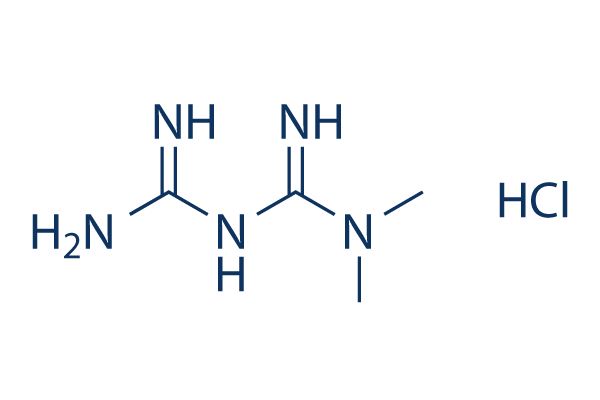
Structure chimique
Poids moléculaire: 165.62
Contrôle Qualité (Quality Control)
Produits souvent utilisés avec Metformin Hydrochloride
| Cibles apparentées | Dehydrogenase HSP Transferase P450 (e.g. CYP17) PDE phosphatase PPAR Vitamin Mitochondrial Metabolism Casein Kinase |
|---|---|
| Autre Carbohydrate Metabolism Inhibiteurs | 2-DG (2-Deoxy-D-glucose) Bromopyruvic acid (3-BP) Dorzagliatin LY2608204 Voglibose 1-Deoxynojirimycin 4',7-Dimethoxy-5-Hydroxyflavone FBPase-1 inhibitor-1 AZD1656 Nodakenetin |
Culture cellulaire, traitement et concentration de travail
(Cell Culture, Treatment & Working Concentration)
| Lignées cellulaires | Type d'essai | Concentration | Temps d'incubation | Formulation | Description de l'activité | PMID |
|---|---|---|---|---|---|---|
| human HepG2 cells | Function assay | 1 mM | 24 h | Activation of AMPK in human HepG2 cells assessed as reduction of gluconeogenesis at 1 mM after 24 hrs by enzymatic colorimetric assay | 26471090 | |
| mouse 3T3L1 cells | Function assay | 1 mM | Induction of AMPK phosphorylation in mouse 3T3L1 cells at 1 mM by Western blot analysis | 25216379 | ||
| human HepG2 cells | Function assay | 1 mM | 24 h | Reduction of glucose consumption in insulin-resistant human HepG2 cells at 1 mM after 24 hrs by glucose oxidase method in presence of 22.2 mM of glucose | 23025244 | |
| human MDA-MB-231 cells | Function assay | 1 to 20 mM | 24 h | Antiproliferative activity against human MDA-MB-231 cells at 1 to 20 mM after 24 hrs by MTT assay. | 22459208 | |
| human HepG2 cells | Function assay | 24 h | Increase in glucose consumption in insulin-resistant human HepG2 cells after 24 hrs, EC50=0.27 μM. | 21856048 | ||
| Hs575T | Function assay | 20 mM | 24 hrs | Inhibition of mTOR phosphorylation in triple-negative human Hs575T cells at 20 mM after 24 hrs by immunoblot analysis | 23490148 | |
| Hs578T | Antiinvasive assay | 20 mM | 17 hrs | Antiinvasive activity against triple-negative human Hs578T cells at 20 mM after 17 hrs by light microscopic analysis | 23490148 | |
| Hs575T | Function assay | 20 mM | 24 hrs | Activation of AMPK in triple-negative human Hs575T cells at 20 mM after 24 hrs by immunoblot analysis | 23490148 | |
| L6 | Function assay | 2 mM | 4 hrs | Increase in glucose uptake in rat L6 cells at 2 mM treated for 4 hrs post 30 mins AMPK inhibitor compound C treatment | 29128163 | |
| HepG2 | Function assay | 1 mM | 24 hrs | Induction of glucose consumption in human HepG2 cells at 1 mM incubated for 24 hrs | 28651984 | |
| Cliquez pour voir plus de données expérimentales sur la lignée cellulaire | ||||||
Informations chimiques, stockage et stabilité (Chemical Information, Storage & Stability)
| Poids moléculaire | 165.62 | Formule | C4H11N5.HCl |
Stockage (À compter de la date de réception) | |
|---|---|---|---|---|---|
| N° CAS | 1115-70-4 | Télécharger le SDF | Stockage des solutions mères |
|
|
| Synonymes | 1,1-Dimethylbiguanide HCl | Smiles | CN(C)C(=N)N=C(N)N.Cl | ||
Solubilité (Solubility)
|
In vitro |
Water : 33 mg/mL Ethanol : Insoluble |
Calculateur de molarité
|
In vivo |
|||||
Calculateur de formulation in vivo (Solution claire)
Étape 1 : Saisir les informations ci-dessous (Recommandé : Un animal supplémentaire pour tenir compte des pertes pendant l'expérience)
Étape 2 : Saisir la formulation in vivo (Ceci est seulement le calculateur, pas la formulation. Veuillez nous contacter d'abord s'il n'y a pas de formulation in vivo dans la section Solubilité.)
Résultats du calcul :
Concentration de travail : mg/ml;
Méthode de préparation du liquide maître DMSO : mg médicament prédissous dans μL DMSO ( Concentration du liquide maître mg/mL, Veuillez nous contacter d'abord si la concentration dépasse la solubilité du DMSO du lot de médicament. )
Méthode de préparation de la formulation in vivo : Prendre μL DMSO liquide maître, puis ajouterμL PEG300, mélanger et clarifier, puis ajouterμL Tween 80, mélanger et clarifier, puis ajouter μL ddH2O, mélanger et clarifier.
Méthode de préparation de la formulation in vivo : Prendre μL DMSO liquide maître, puis ajouter μL Huile de maïs, mélanger et clarifier.
Note : 1. Veuillez vous assurer que le liquide est clair avant d'ajouter le solvant suivant.
2. Assurez-vous d'ajouter le(s) solvant(s) dans l'ordre. Vous devez vous assurer que la solution obtenue, lors de l'ajout précédent, est une solution claire avant de procéder à l'ajout du solvant suivant. Des méthodes physiques telles que le vortex, les ultrasons ou le bain-marie chaud peuvent être utilisées pour faciliter la dissolution.
Mécanisme d'action (Mechanism of Action)
| Targets/IC50/Ki |
AMPK
(Hepatocytes) |
|---|---|
| In vitro |
Metformin (500 μM) activates AMPK in hepatocytes, as a result, acetyl-CoA carboxylase (ACC) activity is reduced, fatty acid oxidation is induced, and expression of lipogenic enzymes is suppressed. Metformin (2 mM) activates muscle AMPK and promotes glucose uptake. Metformin (500 μM) or AICAR strongly suppresses SREBP-1 mRNA expression in rat hepatocytes. Metformin ameliorates hyperglycemia without stimulating insulin secretion, promoting weight gain, or causing hypoglycemia. Metformin has beneficial effects on circulating lipids linked to increased cardiovascular risk. Metformin decreases hepatic glucose production and increases skeletal myocyte glucose uptake. Metformin requires LKB1 in the liver to lower blood glucose levels. Metformin (2 mM) leads to a significant increase in the activity of both α1- and α2-containing complexes in muscle cells. Metformin (2 mM) also increases threonine 172 phosphorylation in muscle cells. |
| In vivo |
Metformin (100 mg/ml, po) treatment produces significant decreases in hepatic expression of mRNAs for SREBP-1, FAS, and S14 in SD rats that are consistent with effects documented in cells. Metformin also decreases hepatic lipids in obese mice. Metformin (250 mg/kg, i.p.) increases AMPK phosphorylation in livers of wild-type mice. Metformin (250 mg/kg, i.p.) treatment reduces blood glucose by more than 50% in the wild-type mice on a high-fat diet. Metformin (250 mg/kg, i.p.) treatment also loweres blood glucose in the ob/ob mice by 40%. |
Références |
|
Applications (Applications)
| Méthodes | Biomarqueurs | Images | PMID |
|---|---|---|---|
| Western blot | pSTAT3 (Ser727) / STAT3 / Jak2 / Cdk5 / pNFκB / Bcl-2 / Bcl-XL / c-Myc pACC / ACC / pS6 / S6 TTP / p-STAT3 / STAT3 / c-Myc p-AMPK / AMPK / p-mTOR / mTOR / p-S6K / S6K |

|
28114390 |
| Immunofluorescence | beta-catenin / AMPK CD86 / CD206 PAR LKB1 |

|
30854043 |
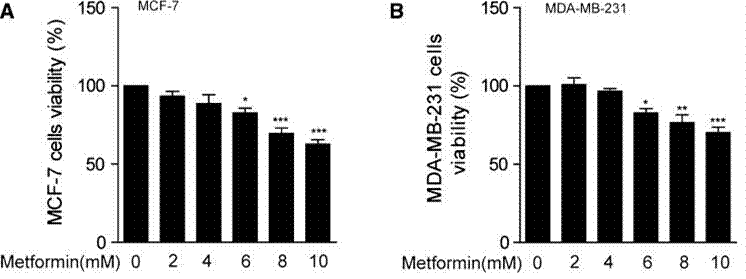
| Growth inhibition assay | Cell viability |
|
26956973 |
Informations sur l'essai clinique (Clinical Trial Information)
(données du https://clinicaltrials.gov, mis à jour le 2024-05-22)
| Numéro NCT | Recrutement | Conditions | Promoteur/Collaborateurs | Date de début | Phases |
|---|---|---|---|---|---|
| NCT05910554 | Not yet recruiting | Sarcoidosis Pulmonary |
University of Maryland Baltimore |
2024-05-01 | Phase 2 |
| NCT06120881 | Recruiting | Type 2 Diabetes |
University of California San Francisco|National Institute of Diabetes and Digestive and Kidney Diseases (NIDDK) |
2024-04-01 | Early Phase 1 |
| NCT06147050 | Not yet recruiting | Long COVID |
Purpose Life Sciences |
2024-04 | Phase 3 |
| NCT06296836 | Not yet recruiting | Diabetes Mellitus Type 2 |
University of Illinois at Chicago|Emily Hanners|Dulal Bhaumik|Avisek Datta|Peggy Choye|Hailey Soni|Annesti Elmasri|Julie Jun|Colin Goodman |
2024-04-01 | Phase 4 |

Les produits sont destinés à la recherche uniquement. Ne pas utiliser chez l'homme. Nous ne vendons pas aux patients.
©Copyright 2013 Selleck Chemicals. Tous droits réservés.