
pour la recherche uniquement
Taurochenodeoxycholic acid Caspase Activateur
Réf. Catalogue: S3865
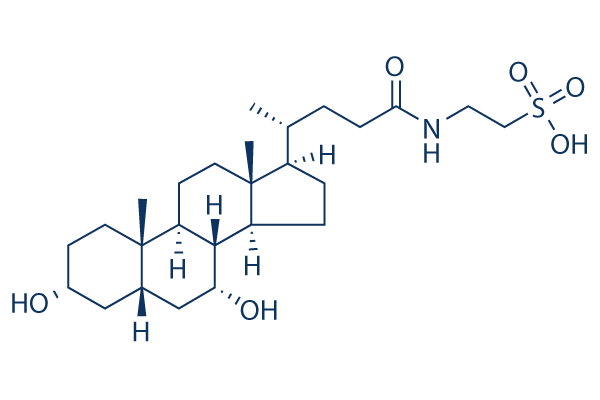
Structure chimique
Poids moléculaire: 499.70
Contrôle Qualité (Quality Control)
| Cibles apparentées | Bcl-2 PD-1/PD-L1 Ferroptosis p53 Apoptosis related Synthetic Lethality STAT TNF-alpha Ras KRas |
|---|---|
| Autre Caspase Inhibiteurs | Emricasan (IDN-6556) Z-VAD-FMK Q-VD-Oph Z-DEVD-FMK Belnacasan (VX-765) Z-IETD-FMK Ac-DEVD-CHO Z-LEHD-FMK TFA Z-VAD(OH)-FMK PAC-1 |
Informations chimiques, stockage et stabilité (Chemical Information, Storage & Stability)
| Poids moléculaire | 499.70 | Formule | C26H45NO6S |
Stockage (À compter de la date de réception) | |
|---|---|---|---|---|---|
| N° CAS | 516-35-8 | -- | Stockage des solutions mères |
|
|
| Synonymes | Taurochenodeoxycholate, TCDCA, 12-Deoxycholyltaurine, Chenodeoxycholyltaurine, Chenyltaurine | Smiles | CC(CCC(=O)NCCS(=O)(=O)O)C1CCC2C1(CCC3C2C(CC4C3(CCC(C4)O)C)O)C | ||
Solubilité (Solubility)
|
In vitro |
DMSO
: 100 mg/mL
(200.12 mM)
Water : 100 mg/mL Ethanol : Insoluble |
Calculateur de molarité
|
In vivo |
|||||
Calculateur de formulation in vivo (Solution claire)
Étape 1 : Saisir les informations ci-dessous (Recommandé : Un animal supplémentaire pour tenir compte des pertes pendant l'expérience)
Étape 2 : Saisir la formulation in vivo (Ceci est seulement le calculateur, pas la formulation. Veuillez nous contacter d'abord s'il n'y a pas de formulation in vivo dans la section Solubilité.)
Résultats du calcul :
Concentration de travail : mg/ml;
Méthode de préparation du liquide maître DMSO : mg médicament prédissous dans μL DMSO ( Concentration du liquide maître mg/mL, Veuillez nous contacter d'abord si la concentration dépasse la solubilité du DMSO du lot de médicament. )
Méthode de préparation de la formulation in vivo : Prendre μL DMSO liquide maître, puis ajouterμL PEG300, mélanger et clarifier, puis ajouterμL Tween 80, mélanger et clarifier, puis ajouter μL ddH2O, mélanger et clarifier.
Méthode de préparation de la formulation in vivo : Prendre μL DMSO liquide maître, puis ajouter μL Huile de maïs, mélanger et clarifier.
Note : 1. Veuillez vous assurer que le liquide est clair avant d'ajouter le solvant suivant.
2. Assurez-vous d'ajouter le(s) solvant(s) dans l'ordre. Vous devez vous assurer que la solution obtenue, lors de l'ajout précédent, est une solution claire avant de procéder à l'ajout du solvant suivant. Des méthodes physiques telles que le vortex, les ultrasons ou le bain-marie chaud peuvent être utilisées pour faciliter la dissolution.
Mécanisme d'action (Mechanism of Action)
| In vitro |
Taurochenodeoxycholic acid (TUDCA) induces dissociation of CD34+ HSCs from stromal cells by decreasing adhesion molecule expression. It induces bone marrow stem cell mobilization and differentiation into endothelial progenitor cells (EPCs) and enhances EPC proliferation, invasion, and tube formation via Akt and ERK activation. TCDCA induces the apoptosis process through the activation of caspase cascade in macrophages, and this process may be involved in PKC/JNK signaling pathway.
|
|---|---|
| In vivo |
TUDCA has neuroprotective effects in neuronal cultures and positive effects on ischemia reperfusion in animal models, reducing infarct area and inflammation via attenuation of endoplasmic reticulum (ER) stress. TUDCA is incorporated into target cells via organic anion transporter (OATP) 2, OATP8, and the Na+‐taurocholate cotransporting polypeptide (NTCP). TUDCA inhibits neointimal hyperplasia by promoting apoptosis of smooth muscle cells via induction of MAP kinase phosphatase‐1 (MKP‐1) expression. In addition, TUDCA protects the hepatocytes and restores glucose homeostasis by reducing ER stress. TUDCA enhances neovascularization in vivo. TCDCA in dosages of 0.05 and 0.1g/kg can extremely significantly decrease the pulmonary coefficient in the model mice. TCDCA in a dosage of 0.2g/kg significantly decreases the pulmonary coefficient in the model mice (P<0.05); TCDCA in dosages of 0.05 and 0.1g/kg significantly reduce the pathological damages on their lungs; TCDCA can extremely significantly decrease the expression levels of TNF-α and TIMP-2 in pulmonary tissues in the pulmonary fibrosis mice (P>0.01), the expression level of MMP-9 extremely significantly increased (P>0.01), while it has no significant effects on MMP2. Thus, TCDCA has antagonistic actions on pulmonary fibrosis in mice.
|
Références |
|

Les produits sont destinés à la recherche uniquement. Ne pas utiliser chez l'homme. Nous ne vendons pas aux patients.
©Copyright 2013 Selleck Chemicals. Tous droits réservés.