
pour la recherche uniquement
Patupilone (Epothilone B) Microtubule Associated inhibiteur
Réf. CatalogueS1364
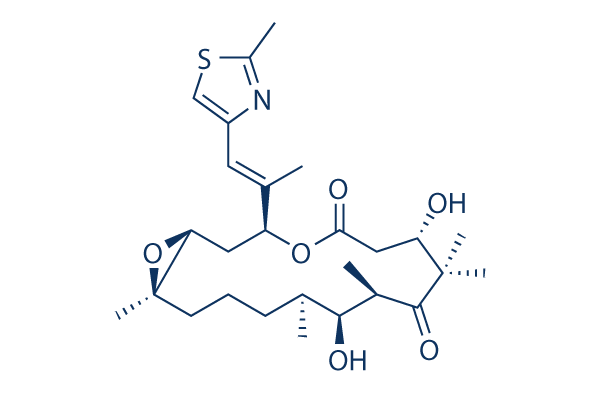
Structure chimique
Poids moléculaire: 507.68
Contrôle Qualité
| Cibles apparentées | Akt Wnt/beta-catenin PKC HSP ROCK Integrin Bcr-Abl Actin FAK Kinesin |
|---|---|
| Autre Microtubule Associated Inhibiteurs | Nocodazole MMAF Lexibulin (CYT997) CW069 Combretastatin A4 Epothilone A ABT-751 (E7010) TAI-1 Cucurbitacin B INH1 |
Culture cellulaire, traitement et concentration de travail
| Lignées cellulaires | Type dessai | Concentration | Temps dincubation | Formulation | Description de lactivité | PMID |
|---|---|---|---|---|---|---|
| human LC-2-ad cell | Growth inhibition assay | Inhibition of human LC-2-ad cell growth in a cell viability assay, IC50=3.77e-06 μM | ||||
| human A431 cell | Growth inhibition assay | Inhibition of human A431 cell growth in a cell viability assay, IC50=9.86e-06 μM | ||||
| human SW1710 cell | Growth inhibition assay | Inhibition of human SW1710 cell growth in a cell viability assay, IC50=2.14e-05 μM | ||||
| human Daoy cell | Growth inhibition assay | Inhibition of human Daoy cell growth in a cell viability assay, IC50=2.73e-05 μM | ||||
| human BFTC-905 cell | Growth inhibition assay | Inhibition of human BFTC-905 cell growth in a cell viability assay, IC50=4.99e-05 μM | ||||
| human A375 cell | Growth inhibition assay | Inhibition of human A375 cell growth in a cell viability assay, IC50=5e-05 μM | ||||
| human RKO cell | Growth inhibition assay | Inhibition of human RKO cell growth in a cell viability assay, IC50=6.47e-05 μM | ||||
| human KYSE-510 cell | Growth inhibition assay | Inhibition of human KYSE-510 cell growth in a cell viability assay, IC50=7.38e-05 μM | ||||
| human HLE cell | Growth inhibition assay | Inhibition of human HLE cell growth in a cell viability assay, IC50=8.26e-05 μM | ||||
| human MCF7 cell | Growth inhibition assay | Inhibition of human MCF7 cell growth in a cell viability assay, IC50=8.66e-05 μM | ||||
| human 786-0 cell | Growth inhibition assay | Inhibition of human 786-0 cell growth in a cell viability assay, IC50=0.11 nM | ||||
| human TE-8 cell | Growth inhibition assay | Inhibition of human TE-8 cell growth in a cell viability assay, IC50=0.111 nM | ||||
| ovarian carcinoma 1A9 cell | Growth inhibition assay | Inhibitory concentration against ovarian carcinoma 1A9 cell growth | ||||
| human PANC-03-27 cell | Growth inhibition assay | Inhibition of human PANC-03-27 cell growth in a cell viability assay, IC50=0.132 μM | ||||
| human VMRC-RCZ cell | Growth inhibition assay | Inhibition of human VMRC-RCZ cell growth in a cell viability assay, IC50=0.136 μM | ||||
| human IGROV-1 cell | Growth inhibition assay | Inhibition of human IGROV-1 cell growth in a cell viability assay, IC50=0.156 μM | ||||
| human MG-63 cell | Growth inhibition assay | Inhibition of human MG-63 cell growth in a cell viability assay, IC50=0.165 μM | ||||
| human SIG-M5 cell | Growth inhibition assay | Inhibition of human SIG-M5 cell growth in a cell viability assay, IC50=0.169 μM | ||||
| human NCI-H650 cell | Growth inhibition assay | Inhibition of human NCI-H650 cell growth in a cell viability assay, IC50=0.17 μM | ||||
| human PSN1 cell | Growth inhibition assay | Inhibition of human PSN1 cell growth in a cell viability assay, IC50=0.173 μM | ||||
| human PA-1 cell | Growth inhibition assay | Inhibition of human PA-1 cell growth in a cell viability assay, IC50=0.174 μM | ||||
| KB-8511 cells | Growth inhibition assay | 72 h | Concentration required to inhibit the growth of human epidermoid carcinoma cells KB-8511 by 50 percent (72 hr exposure), IC50=0.18 μM | |||
| KB-31 cells | Growth inhibition assay | 72 h | Concentration required to inhibit the growth of human epidermoid carcinoma cells KB-31 by 50 percent (72 hr exposure) | |||
| human BHY cell | Growth inhibition assay | Inhibition of human BHY cell growth in a cell viability assay, IC50=0.195 nM | ||||
| human BB30-HNC cell | Growth inhibition assay | Inhibition of human BB30-HNC cell growth in a cell viability assay, IC50=0.201 μM | ||||
| human HOS cell | Growth inhibition assay | Inhibition of human HOS cell growth in a cell viability assay, IC50=0.215 μM | ||||
| human 639-V cell | Growth inhibition assay | Inhibition of human 639-V cell growth in a cell viability assay, IC50=0.218 μM | ||||
| human ES1 cell | Growth inhibition assay | Inhibition of human ES1 cell growth in a cell viability assay, IC50=0.221 μM | ||||
| human TE-15 cell | Growth inhibition assay | Inhibition of human TE-15 cell growth in a cell viability assay, IC50=0.225 μM | ||||
| human LXF-289 cell | Growth inhibition assay | Inhibition of human LXF-289 cell growth in a cell viability assay, IC50=0.277 μM | ||||
| human CAL-12T cell | Growth inhibition assay | Inhibition of human CAL-12T cell growth in a cell viability assay, IC50=0.239 μM | ||||
| human T84 cell | Growth inhibition assay | Inhibition of human T84 cell growth in a cell viability assay, IC50=0.24 μM | ||||
| human KYSE-450 cell | Growth inhibition assay | Inhibition of human KYSE-450 cell growth in a cell viability assay, IC50=0.267 μM | ||||
| human LCLC-103H cell | Growth inhibition assay | Inhibition of human LCLC-103H cell growth in a cell viability assay, IC50=0.31 nM | ||||
| human NCI-H810 cell | Growth inhibition assay | Inhibition of human NCI-H810 cell growth in a cell viability assay, IC50=0.322 μM | ||||
| human HUTU-80 cell | Growth inhibition assay | Inhibition of human HUTU-80 cell growth in a cell viability assay, IC50=0.328 μM | ||||
| human NCI-H460 cell | Growth inhibition assay | Inhibition of human NCI-H460 cell growth in a cell viability assay, IC50=0.333 μM | ||||
| human HGC-27 cell | Growth inhibition assay | Inhibition of human HGC-27 cell growth in a cell viability assay, IC50=0.338 μM | ||||
| human HSC-2 cell | Growth inhibition assay | Inhibition of human HSC-2 cell growth in a cell viability assay, IC50=0.363 nM | ||||
| human IA-LM cell | Growth inhibition assay | Inhibition of human IA-LM cell growth in a cell viability assay, IC50=0.393 μM | ||||
| human HMV-II cell | Growth inhibition assay | Inhibition of human HMV-II cell growth in a cell viability assay, IC50=0.394 μM | ||||
| human COLO-679 cell | Growth inhibition assay | Inhibition of human COLO-679 cell growth in a cell viability assay, IC50=0.394 μM | ||||
| human NCI-H2122 cell | Growth inhibition assay | Inhibition of human NCI-H2122 cell growth in a cell viability assay, IC50=0.41 μM | ||||
| human CAL-39 cell | Growth inhibition assay | Inhibition of human CAL-39 cell growth in a cell viability assay, IC50=0.411 μM | ||||
| human SW954 cell | Growth inhibition assay | Inhibition of human SW954 cell growth in a cell viability assay, IC50=0.436 μM | ||||
| human LCLC-97TM1 cell | Growth inhibition assay | Inhibition of human LCLC-97TM1 cell growth in a cell viability assay, IC50=0.444 μM | ||||
| human KYSE-270 cell | Growth inhibition assay | Inhibition of human KYSE-270 cell growth in a cell viability assay, IC50=0.445 μM | ||||
| human NB13 cell | Growth inhibition assay | Inhibition of human NB13 cell growth in a cell viability assay, IC50=0.447 μM | ||||
| human SK-LMS-1 cell | Growth inhibition assay | Inhibition of human SK-LMS-1 cell growth in a cell viability assay, IC50=0.646 μM | ||||
| human SW620 cell | Growth inhibition assay | Inhibition of human SW620 cell growth in a cell viability assay, IC50=0.648 μM | ||||
| human HCT-15 cell | Growth inhibition assay | Inhibition of human HCT-15 cell growth in a cell viability assay, IC50=0.717 μM | ||||
| human DU-145 cell | Growth inhibition assay | Inhibition of human DU-145 cell growth in a cell viability assay, IC50=0.721 μM | ||||
| human ST486 cell | Growth inhibition assay | Inhibition of human ST486 cell growth in a cell viability assay, IC50=0.721 μM | ||||
| human A427 cell | Growth inhibition assay | Inhibition of human A427 cell growth in a cell viability assay, IC50=0.828 μM | ||||
| human HT-1080 cell | Growth inhibition assay | Inhibition of human HT-1080 cell growth in a cell viability assay, IC50=0.842 μM | ||||
| human NCI-H2009 cell | Growth inhibition assay | Inhibition of human NCI-H2009 cell growth in a cell viability assay, IC50=0.862 μM | ||||
| human SK-LU-1 cell | Growth inhibition assay | Inhibition of human SK-LU-1 cell growth in a cell viability assay, IC50=0.866 μM | ||||
| human SCC-4 cell | Growth inhibition assay | Inhibition of human SCC-4 cell growth in a cell viability assay, IC50=0.877 μM | ||||
| human NCI-H1299 cell | Growth inhibition assay | Inhibition of human NCI-H1299 cell growth in a cell viability assay, IC50=0.88 μM | ||||
| human NH-12 cell | Growth inhibition assay | Inhibition of human NH-12 cell growth in a cell viability assay, IC50=0.891 μM | ||||
| human SK-UT-1 cell | Growth inhibition assay | Inhibition of human SK-UT-1 cell growth in a cell viability assay, IC50=0.892 μM | ||||
| human Bel7402 | Proliferation assay | 72 h | Antiproliferative activity against human Bel7402 after 72 hrs by CellTiter Glo assay, IC50=0.9 μM | |||
| human A388 cell | Growth inhibition assay | Inhibition of human A388 cell growth in a cell viability assay, IC50=0.94 μM | ||||
| human SW982 cell | Growth inhibition assay | Inhibition of human SW982 cell growth in a cell viability assay, IC50=0.999 μM | ||||
| Cliquez pour voir plus de données expérimentales sur la lignée cellulaire | ||||||
Informations chimiques, stockage et stabilité
| Poids moléculaire | 507.68 | Formule | C27H41NO6S |
Stockage (À compter de la date de réception) | |
|---|---|---|---|---|---|
| N° CAS | 152044-54-7 | Télécharger le SDF | Stockage des solutions mères |
|
|
| Synonymes | EPO906 | Smiles | CC1CCCC2(C(O2)CC(OC(=O)CC(C(C(=O)C(C1O)C)(C)C)O)C(=CC3=CSC(=N3)C)C)C | ||
Solubilité
|
In vitro |
DMSO
: 102 mg/mL
(200.91 mM)
Ethanol : 102 mg/mL Water : Insoluble |
Calculateur de molarité
|
In vivo |
|||||
Calculateur de formulation in vivo (Solution claire)
Étape 1 : Saisir les informations ci-dessous (Recommandé : Un animal supplémentaire pour tenir compte des pertes pendant lexpérience)
Étape 2 : Saisir la formulation in vivo (Ceci est seulement le calculateur, pas la formulation. Veuillez nous contacter dabord sil ny a pas de formulation in vivo dans la section Solubilité.)
Résultats du calcul :
Concentration de travail : mg/ml;
Méthode de préparation du liquide maître DMSO : mg médicament prédissous dans μL DMSO ( Concentration du liquide maître mg/mL, Veuillez nous contacter dabord si la concentration dépasse la solubilité du DMSO du lot de médicament. )
Méthode de préparation de la formulation in vivo : Prendre μL DMSO liquide maître, puis ajouterμL PEG300, mélanger et clarifier, puis ajouterμL Tween 80, mélanger et clarifier, puis ajouter μL ddH2O, mélanger et clarifier.
Méthode de préparation de la formulation in vivo : Prendre μL DMSO liquide maître, puis ajouter μL Huile de maïs, mélanger et clarifier.
Note : 1. Veuillez vous assurer que le liquide est clair avant dajouter le solvant suivant.
2. Assurez-vous dajouter le(s) solvant(s) dans lordre. Vous devez vous assurer que la solution obtenue, lors de lajout précédent, est une solution claire avant de procéder à lajout du solvant suivant. Des méthodes physiques telles que le vortex, les ultrasons ou le bain-marie chaud peuvent être utilisées pour faciliter la dissolution.
Mécanisme daction
| Targets/IC50/Ki |
Tubulin
(Cell-free assay) 1.8 μM(EC0.01)
|
|---|---|
| In vitro |
Patupilone (Epothilone B) montre une meilleure activité que l'épothilone A, avec un EC0.01 de 1,8 μM. Il inhibe puissamment la prolifération cellulaire dans les cellules HCT116, avec une IC50 de 0,8 nM. Ce composé induit un arrêt mitotique et présente une cytotoxicité dans les cellules KB3-1, KBV-1, Hela et Hs578T, avec une IC50 de 3 nM à 92 nM. Il entre en compétition avec le Taxol pour la liaison aux microtubules, avec une IC50 de 3,3 μM. Dans les cellules MCF-7 surexprimant la GFP-α-tubuline, il (3,5 nM) bloque efficacement la dynamique des microtubules. Parallèlement, il induit un arrêt mitotique avec une IC50 de 3,5 nM. Dans les cellules de myélome multiple (MM), y compris RPMI 8226, U266, MM.1S, LR5 et MR20, il supprime directement la prolifération avec une IC50 de 1 nM à 10 nM. De même, il (10 nM) induit également un arrêt du cycle cellulaire et l'apoptose. Une étude récente révèle que, dans les cellules ovariennes cancéreuses Hey, il (5 nM-100 nM) améliore l'antigène d'adhésion des cellules épithéliales de surface (EpCAM), sans affecter la transcription ou le niveau cellulaire total d'EpCAM. |
| Essai kinase |
Test de polymérisation de la tubuline
|
|
Les protéines de microtubule (MTP) de cerveau de veau sont purifiées, ce qui comprend environ 15% à 20% de protéines associées aux microtubules. Le tampon (tampon MES) utilisé pour les études Epothilone B-microtubule contient 0,1 M d'acide 2-morpholinoéthanesulfonique (MES), 1 mM d'EGTA et 0,5 mM de MgCl2 à pH 6,6. Les échantillons pour la microscopie électronique sont placés sur des grilles recouvertes de carbone-Parlodion (300 mesh) et colorés négativement avec 2% d'acétate d'uranyle. L'assemblage des microtubules en présence ou en l'absence de Patupilone (Epothilone B) est surveillé spectrophotométriquement à l'aide d'un spectrophotomètre équipé d'un circulateur de liquide à régulation thermostatique. La température est maintenue à 35 °C et les changements de turbidité (représentatifs de la masse polymère) sont surveillés à 350 nm. La concentration efficace (EC0.01), définie comme la concentration interpolée capable d'induire une pente initiale de 0,01 DO/min, est calculée à l'aide de la formule EC0.01 = concentration/pente et exprimée comme la moyenne avec l'écart type obtenu à partir de trois concentrations différentes.
|
|
| In vivo |
Dans un modèle de xénogreffe de souris de cellules RPMI 8226, le Patupilone (Epothilone B) (2,5 mg/kg-4 mg/kg) prolonge la survie et supprime la croissance tumorale. De même, ce composé à la même dose inhibe également la croissance tumorale dans des modèles de xénogreffe de souris de cellules de cancer de la prostate, y compris DU145 et PC3. |
Références |
|
Informations sur lessai clinique
(données du https://clinicaltrials.gov, mis à jour le 2024-05-22)
| Numéro NCT | Recrutement | Conditions | Promoteur/Collaborateurs | Date de début | Phases |
|---|---|---|---|---|---|
| NCT00496600 | Completed | Refractory Malignancy |
University of Medicine and Dentistry of New Jersey|Novartis Pharmaceuticals|National Cancer Institute (NCI)|Rutgers The State University of New Jersey |
July 2007 | Phase 1 |
| NCT00442741 | Withdrawn | Solid Tumors |
Novartis Pharmaceuticals|Novartis |
July 2007 | Phase 1 |
| NCT00468260 | Terminated | Advanced Malignancies |
Novartis Pharmaceuticals|Novartis |
May 2007 | Phase 1 |
| NCT00448396 | Completed | Advanced Malignancies |
Novartis Pharmaceuticals|Novartis |
March 2007 | Phase 1 |
| NCT00426140 | Completed | Advanced Malignancies|Solid Tumors |
Novartis Pharmaceuticals|Novartis |
August 2006 | Phase 1 |
Support technique
Tel: +1-832-582-8158 Ext:3
Si vous avez dautres questions, veuillez laisser un message.

Les produits sont destinés à la recherche uniquement. Ne pas utiliser chez lhomme. Nous ne vendons pas aux patients.
©Copyright 2013 Selleck Chemicals. Tous droits réservés.